| Product Name | Anti-CD3 & DLL3 Reference Antibody (Tarlatamab) |
|---|---|
| Target | DLL3,CD3 |
| source | P07766 & Q9NYJ7 |
| Concentration(mg/mL) | 1 mg/mL |
| Clonality | Bispecific |
| Isotype | HLE-BiTE |
| Reactivity | Human |
| Molecular Weight (kDa) | 105.2 kDa |
| Endotoxin | <1 EU/mg |
| Conjugation | Unconjugated |
| Expression System | CHO |
| Purification | Protein A |
| Application | ELISA,Bioactivity: FACS,Functional assay,Research in vivo,Kinetics (SPR) |
| Formulation | Liquid:100mM Pro-Ac, 20mM Arg pH 5.0 Lyophilization: 25mM histidine, 8% sucrose, 0.01% Tween80 pH6.2 |
| Reconstitution | For Powder, reconstitute with sterile, distilled water to a final sybconcentration of 1 mg/ml. Gently shake to solubilize completely. Do not vortex. |
| Storage | Upon receipt, store immediately at -20℃ or lower for 24 months. Store aliquots at -80°C for up to 3 months. Avoid repeated freeze-thaw cycles. |
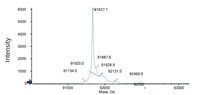
MASS
The detected molecular weight of Anti-CD3 & DLL3 Reference Antibody (Tarlatamab) is 91.84 kDa. The antibody sequence matches the sequence in patent (WO2017021349).The Mass data suggested a smaller molecular weight of Tarlatamab (91.84 kDa) than the theoretical value (105.2 kDa, from the above patent). Functional assays domenstrated Tarlatamab retains the function of CD3 and DLL3.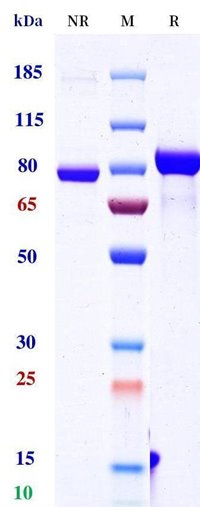
Purity: SDS-PAGE
Anti-CD3 & DLL3 Reference Antibody (Tarlatamab) on SDS-PAGE under reducing (R) condition. The purity of the protein is greater than 95%.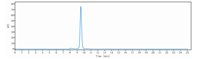
Purity: SEC-HPLC
The purity of Anti-CD3 & DLL3 Reference Antibody (Tarlatamab) is 94.53%, determined by SEC-HPLC.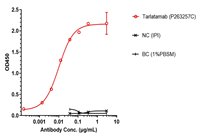
ELISA
Tarlatamab bound to DLL3 protein, and then rebounded to secondary antibodies(Anti-human-IgG-Fc-HRP) , and read OD450. As shown in fig, Tarlatamab bound to huPD-1-his, and the EC50 was 0.010 nM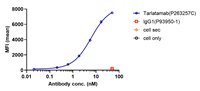
Bioactivity: FACS
Tarlatamab bound to huCD3e-jurkat cells, and then rebounded to fluorescent secondary antibodies(Anti-human IgG, Fcγ PE) , and test by flow cytometry. As shown in fig, Tarlatamab bound to huCD3e-jurkat cells, and the EC50 was 6.141 nM.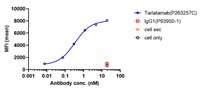
Bioactivity: FACS
Tarlatamab bound to hu-DLL3-HEK293 cells, and then rebounded to fluorescent secondary antibodies(Anti-human IgG, Fcγ PE) , and test by flow cytometry. As shown in fig, Tarlatamab bound to hu-DLL3-HEK293 cells, and the EC50 was 0.337 nM.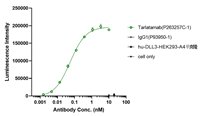
Function: Luciferase
Co-incubation of Tarlatamab with Jurkat cells, then with the addition of hu-DLL3-HEK293 cells for 6 hours. Bright-Lite was used to detect the fluorescent signal.As shown in fig, Tarlatamab was able to activate the NF-AT signaling pathway, and the EC50 was 0.056 nM.


