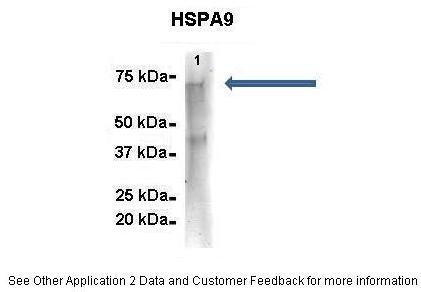
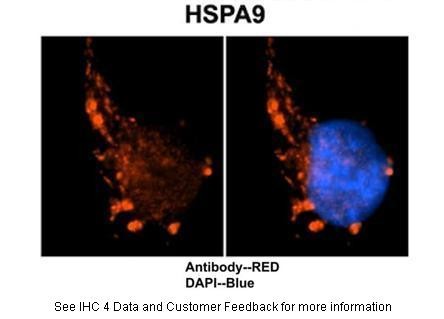
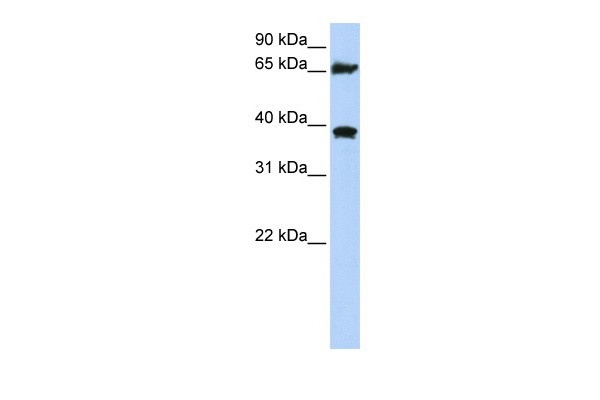
Western blot
500 ug mouse brain homogenateAmount of IP Antibody :6 ugPrimary Antibody :HSPA9Primary Antibody Dilution :1:500Secondary Antibody :Goat anti-rabbit Alexa-Fluor 594Secondary Antibody Dilution :1:5000Gene Name :HSPA9Submitted by :Dr. Yuzhi Chen, University of Arkansas for Medical ScienceImmunofluorescence
Human brain stem cellsPrimary Antibody Dilution :1:500Secondary Antibody :Goat anti-rabbit Alexa-Fluor 594Secondary Antibody Dilution :1:1000Color/Signal Descriptions :HSPA9: Red DAPI:BlueGene Name :HSPA9Submitted by :Dr. Yuzhi Chen, University of Arkansas for Medical ScienceImmunohistochemical
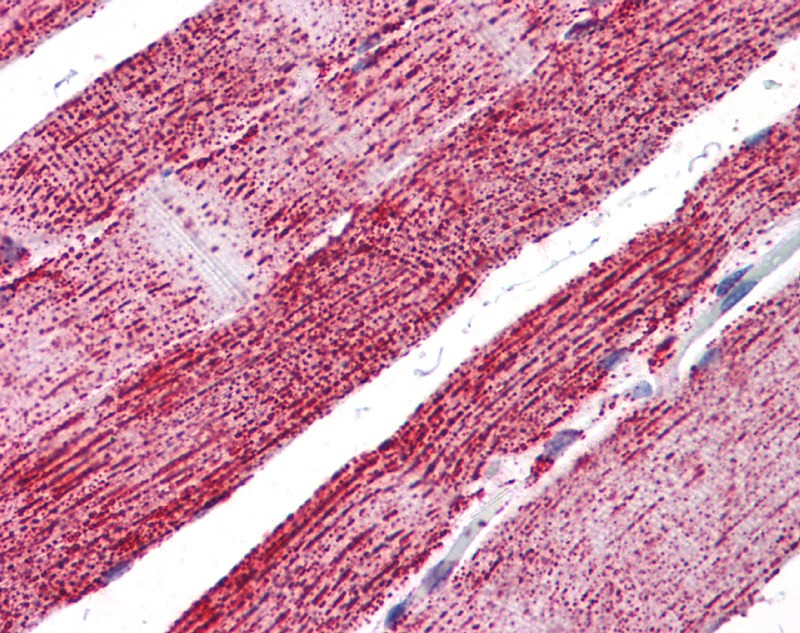
Skeletal muscleImmunohistochemical
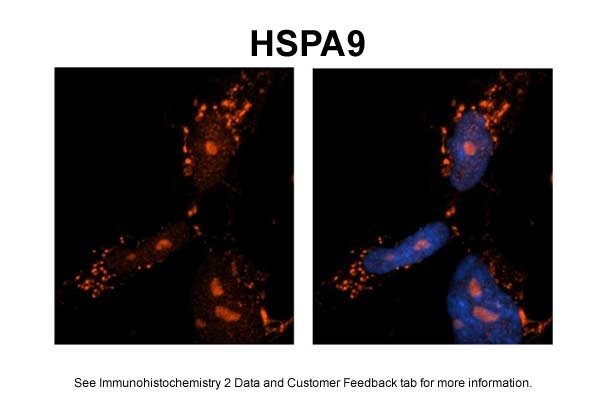
Data Provided by Dr. Yuzhi Chen, University of Arkansas for Medical SciencesNT2 cells were pretreated with 2N HCL for 30 minutesWashed 3x in PBSStained for 2 hours with 1ug/50ul antibodyand Incubated in Alexa goat-rabbit 594 for 1H.Images were obtained with a 40x objectiveNT-2 cellsAntibody: RedDAPI: BlueWestern blot
0.2-1 ug/mlELISA Titer: 1:62500Positive Control: 293T cell lysate| Product Name | Rabbit anti-HSPA9 polyclonal antibody - C-terminal region |
|---|---|
| Antibody Type | Primary Antibodies |
| Antigen Alias | CSA, GRP75, HSPA9B, MGC4500, MOT, MOT2, MTHSP75, PBP74, mot-2, GRP-75 |
| Immunogen | The immunogen for anti-HSPA9 antibody: synthetic peptide directed towards the C terminal of human HSPA9 |
| Clonality | Polyclonal |
|---|---|
| Isotype | IgG |
| Host Species | Rabbit |
| Tested Applications | WBIHCIP |
| WB:1:500~1:2000 IHC:1:50~1:200 IP:1:100~1:500 Notes:Optimal dilutions/concentrations should be determined by the researcher. |
|
| Species Reactivity | DogHorseHumanMousePigRabbitRat |
| Concentration | 1mg/ml |
| Purification | Affinity purified |
| Gene Symbol | HSPA9 |
|---|---|
| Gene Synonyms | CSA GRP75 HSPA9B MGC4500 MOT MOT2 MTHSP75 PBP74 mot-2 GRP-75 |
| Gene Full Name | Heat shock 70kDa protein 9 (mortalin) |
| Gene Summary | HSPA9 belongs to the heat shock protein 70 family which contains both heat-inducible and constitutively expressed members. The latter are called heat-shock cognate proteins. HSPA9 is a heat-shock cognate protein. This protein plays a role in the control of cell proliferation. It may also act as a chaperone.CSHL1 is a member of the somatotropin/prolactin family of hormones which play an important role in growth control. This particular family member is expressed in placental villi, although it was originally thought to be a pseudogene. In fact, alternative splicing suggests that the majority of the transcripts would be unable to express a secreted protein.The product encoded by this gene belongs to the heat shock protein 70 family which contains both heat-inducible and constitutively expressed members. The latter are called heat-shock cognate proteins. This gene encodes a heat-shock cognate protein. This protein plays a role in the control of cell proliferation. It may also act as a chaperone. Sequence Note: The RefSeq transcript and protein were derived from genomic sequence to make the sequence consistent with the reference genome assembly. The genomic coordinates used for the transcript record were based on alignments. Publication Note: This RefSeq record includes a subset of the publications that are available for this gene. Please see the Entrez Gene record to access additional publications. The protein encoded by this gene is an inositol 1,4,5-trisphosphate (InsP3) 5-phosphatase and contains a Sac domain. The activity of this protein is specific for phosphatidylinositol 4,5-bisphosphate and phosphatidylinositol 3,4,5-trisphosphate. Alternatively spliced transcript variants have been observed, but most of them are not thought to be protein-coding. |
| Alternative Names | CSA GRP75 HSPA9B MGC4500 MOT MOT2 MTHSP75 PBP74 mot-2 GRP-75 |
| Molecular Weight(MW) | 75kDa |
| Sequence | 679 amino acids |
Western blot
500 ug mouse brain homogenateAmount of IP Antibody :6 ugPrimary Antibody :HSPA9Primary Antibody Dilution :1:500Secondary Antibody :Goat anti-rabbit Alexa-Fluor 594Secondary Antibody Dilution :1:5000Gene Name :HSPA9Submitted by :Dr. Yuzhi Chen, University of Arkansas for Medical Science
Immunofluorescence
Human brain stem cellsPrimary Antibody Dilution :1:500Secondary Antibody :Goat anti-rabbit Alexa-Fluor 594Secondary Antibody Dilution :1:1000Color/Signal Descriptions :HSPA9: Red DAPI:BlueGene Name :HSPA9Submitted by :Dr. Yuzhi Chen, University of Arkansas for Medical Science
Immunohistochemical
Skeletal muscle
Immunohistochemical
Data Provided by Dr. Yuzhi Chen, University of Arkansas for Medical SciencesNT2 cells were pretreated with 2N HCL for 30 minutesWashed 3x in PBSStained for 2 hours with 1ug/50ul antibodyand Incubated in Alexa goat-rabbit 594 for 1H.Images were obtained with a 40x objectiveNT-2 cellsAntibody: RedDAPI: Blue
Western blot
0.2-1 ug/mlELISA Titer: 1:62500Positive Control: 293T cell lysate| Application Notes | WB:1:500~1:2000 IHC:1:50~1:200 IP:1:100~1:500 Notes:Optimal dilutions/concentrations should be determined by the researcher. |
|---|
| Form | Liquid |
|---|---|
| Storage Instructions | Aliquot and store at -20°C. Avoid repeated freeze / thaw cycles |
| Storage Buffer | phosphate buffered saline , pH 7.4, 150mM NaCl, 0.02% sodium azide and 50% glycerol. |


