Chromatin Immunoprecipitation
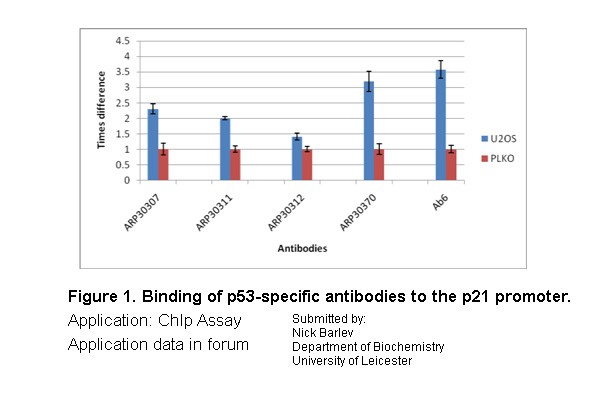
U20S (p53+) cells were treated with 0.5 uM Doxorubicin for 14 hrs to induce DNA damage and hence activate p53. In parallel, PLKO cells (U2OS cells with stable shRNA-mediated knockdown of p53) were treated similarly and were used as negative control. Thedata for p21 promoter were normalised to actin (control for non-specific binding of DNA to the antibodies).Western blot
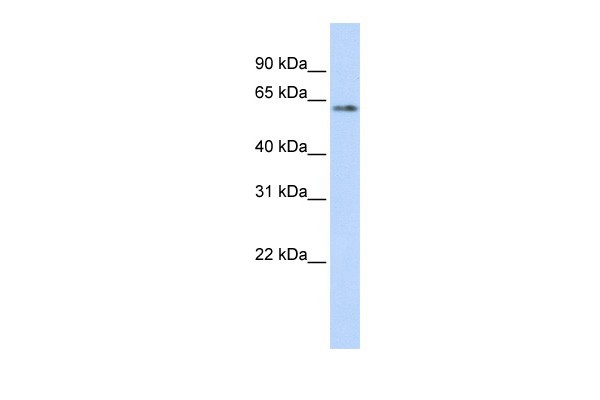
0.2-1 ug/mlELISA Titer: 1:62500Positive Control: 293T cell lysateWestern blot
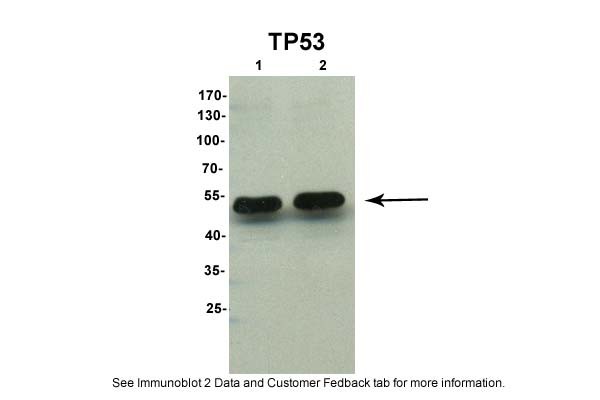
human cystic fibrosis bronchial epithelial cellsP53: 1/1 000Goat anti-rabbit-HRP: 1:5000| Product Name | Rabbit anti-TP53 polyclonal antibody - N-terminal region |
|---|---|
| Antibody Type | Primary Antibodies |
| Antigen Alias | LFS1, TRP53, p53 |
| Immunogen | The immunogen for anti-TP53 antibody: synthetic peptide directed towards the N terminal of human TP53 |
| Clonality | Polyclonal |
|---|---|
| Isotype | IgG |
| Host Species | Rabbit |
| Tested Applications | WBChIP |
| WB:1:500~1:2000 ChIP:1:100~1:500 Notes:Optimal dilutions/concentrations should be determined by the researcher. |
|
| Species Reactivity | Human |
| Concentration | 1mg/ml |
| Purification | Affinity purified |
| Gene Symbol | TP53 |
|---|---|
| Gene Synonyms | LFS1 TRP53 p53 |
| Gene Summary | TP53 acts as a tumor suppressor in many tumor types; induces growth arrest or apoptosis depending on the physiological circumstances and cell type. Involved in cell cycle regulation as a trans-activator that acts to negatively regulate cell division by controlling a set of genes required for this process. This gene encodes tumor protein p53, which responds to diverse cellular stresses to regulate target genes that induce cell cycle arrest, apoptosis, senescence, DNA repair, or changes in metabolism. p53 protein is expressed at low level in normal cells and at a high level in a variety of transformed cell lines, where it's believed to contribute to transformation and malignancy. p53 is a DNA-binding protein containing transcription activation, DNA-binding, and oligomerization domains. It is postulated to bind to a p53-binding site and activate expression of downstream genes that inhibit growth and/or invasion, and thus function as a tumor suppressor. Mutants of p53 that frequently occur in a number of different human cancers fail to bind the consensus DNA binding site, and hence cause the loss of tumor suppressor activity. Alterations of this gene occur not only as somatic mutations in human malignancies, but also as germline mutations in some cancer-prone families with Li-Fraumeni syndrome. Multiple p53 variants due to alternative promoters and multiple alternative splicing have been found. These variants encode distinct isoforms, which can regulate p53 transcriptional activity. |
| Alternative Names | LFS1 TRP53 p53 |
| Molecular Weight(MW) | 44kDa |
| Sequence | 393 amino acids |
Chromatin Immunoprecipitation
U20S (p53+) cells were treated with 0.5 uM Doxorubicin for 14 hrs to induce DNA damage and hence activate p53. In parallel, PLKO cells (U2OS cells with stable shRNA-mediated knockdown of p53) were treated similarly and were used as negative control. Thedata for p21 promoter were normalised to actin (control for non-specific binding of DNA to the antibodies).
Western blot
0.2-1 ug/mlELISA Titer: 1:62500Positive Control: 293T cell lysate
Western blot
human cystic fibrosis bronchial epithelial cellsP53: 1/1 000Goat anti-rabbit-HRP: 1:5000| Application Notes | WB:1:500~1:2000 ChIP:1:100~1:500 Notes:Optimal dilutions/concentrations should be determined by the researcher. |
|---|
| Form | Liquid |
|---|---|
| Storage Instructions | Aliquot and store at -20°C. Avoid repeated freeze / thaw cycles |
| Storage Buffer | phosphate buffered saline , pH 7.4, 150mM NaCl, 0.02% sodium azide and 50% glycerol. |


