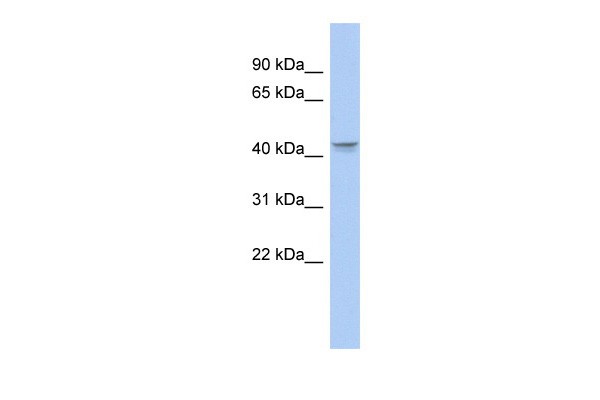
Western blot
0.2-1 ug/mlELISA Titer: 1:62500Positive Control: Human Stomach| Product Name | Rabbit anti-PTGER3 polyclonal antibody - middle region |
|---|---|
| Antibody Type | Primary Antibodies |
| Antigen Alias | EP3, EP3-I, EP3-II, EP3-III, EP3-IV, EP3e, MGC141828, MGC141829, MGC27302, PGE2-R |
| Immunogen | The immunogen for anti-PTGER3 antibody: synthetic peptide directed towards the middle region of human PTGER3 |
| Clonality | Polyclonal |
|---|---|
| Isotype | IgG |
| Host Species | Rabbit |
| Tested Applications | WB |
| WB:1:500~1:2000 Notes:Optimal dilutions/concentrations should be determined by the researcher. |
|
| Species Reactivity | HorseHuman |
| Concentration | 1mg/ml |
| Purification | Affinity purified |
| Gene Symbol | PTGER3 |
|---|---|
| Gene Synonyms | EP3 EP3-I EP3-II EP3-III EP3-IV EP3e MGC141828 MGC141829 MGC27302 PGE2-R |
| Gene Full Name | Prostaglandin E receptor 3 (subtype EP3) |
| Gene Summary | PTGER3 is the receptor for prostaglandin E2 (PGE2); the EP3 receptor may be involved in inhibition of gastric acid secretion, modulation of neurotransmitter release in central and peripheral neurons, inhibition of sodium and water reabsorption in kidney tubulus and contraction in uterine smooth muscle. The activity of this receptor can couple to both the inhibition of adenylate cyclase mediated by G-I proteins, and to an elevation of intracellular calcium. The various isoforms have identical ligand binding properties but can interact with different second messenger systems.The protein encoded by this gene is a member of the G-protein coupled receptor family. This protein is one of four receptors identified for prostaglandin E2 (PGE2). This receptor may have many biological functions, which involve digestion, nervous system, kidney reabsorption, and uterine contraction activities. Studies of the mouse counterpart suggest that this receptor may also mediate adrenocorticotropic hormone response as well as fever generation in response to exogenous and endogenous stimuli. Multiple alternatively spliced transcript variants encoding eight distinct isoforms have been reported. |
| Alternative Names | EP3 EP3-I EP3-II EP3-III EP3-IV EP3e MGC141828 MGC141829 MGC27302 PGE2-R |
| Molecular Weight(MW) | 43kDa |
| Sequence | 390 amino acids |
Western blot
0.2-1 ug/mlELISA Titer: 1:62500Positive Control: Human Stomach| Application Notes | WB:1:500~1:2000 Notes:Optimal dilutions/concentrations should be determined by the researcher. |
|---|
| Form | Liquid |
|---|---|
| Storage Instructions | Aliquot and store at -20°C. Avoid repeated freeze / thaw cycles |
| Storage Buffer | phosphate buffered saline , pH 7.4, 150mM NaCl, 0.02% sodium azide and 50% glycerol. |


