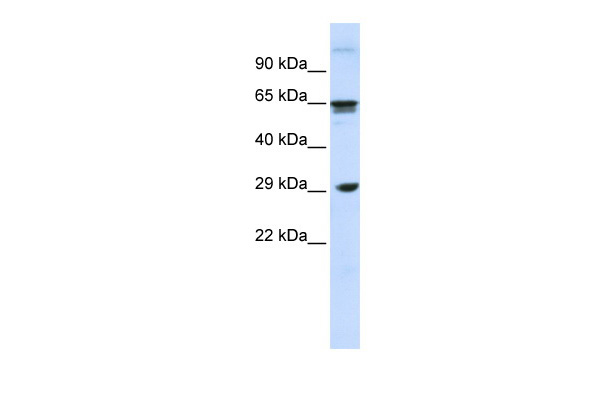
Application
WB Suggested Anti-CLEC4M Antibody Titration: 0.2-1 ug/mlELISA Titer: 1:312500Positive Control: Human Muscle| Product Name | Rabbit anti-CLEC4M polyclonal antibody - N-terminal region |
|---|---|
| Antibody Type | Primary Antibodies |
| Antigen Alias | CD209L, CD299, DC-SIGN2, DC-SIGNR, DCSIGNR, HP10347, L-SIGN, LSIGN, MGC129964, MGC47866 |
| Immunogen | The immunogen for anti-CLEC4M antibody: synthetic peptide directed towards the n terminal of human CLEC4M |
| Clonality | Polyclonal |
|---|---|
| Isotype | IgG |
| Host Species | Rabbit |
| Tested Applications | WB |
| WB:1:500~1:2000 Notes:Optimal dilutions/concentrations should be determined by the researcher. |
|
| Species Reactivity | Human |
| Concentration | 1mg/ml |
| Purification | Affinity purified |
| Gene Symbol | CLEC4M |
|---|---|
| Gene Synonyms | CLEC4M |
| Gene Full Name | C-type lectin domain family 4, member M |
| Gene Summary | CLEC4M is a transmembrane receptor and is often referred to as L-SIGN because of its expression in the endothelial cells of the lymph nodes and liver. It is involved in the innate immune system and recognizes numerous evolutionarily divergent pathogens ranging from parasites to viruses, with a large impact on public health. The protein is organized into three distinct domains: an N-terminal transmembrane domain, a tandem-repeat neck domain and C-type lectin carbohydrate recognition domain. The extracellular region consisting of the C-type lectin and neck domains has a dual function as a pathogen recognition receptor and a cell adhesion receptor by binding carbohydrate ligands on the surface of microbes and endogenous cells. The neck region is important for homo-oligomerization which allows the receptor to bind multivalent ligands with high avidity. Variations in the number of 23 amino acid repeats in the neck domain of this protein are common and have a significant impact on ligand binding ability. This gene is closely related in terms of both sequence and function to a neighboring gene (GeneID 30835; often referred to as DC-SIGN or CD209). DC-SIGN and L-SIGN differ in their ligand-binding properties and distribution. Alternative splicing results in multiple variants.This gene encodes a type II integral membrane protein that is 77% identical to CD209 antigen, a HIV gp120-binding protein. This protein, like CD209, efficiently binds both intercellular adhesion molecule 3 (ICAM3) and HIV-1 gp120, and enhances HIV-1 infection of T cells. This gene is mapped to 19p13.3, in a cluster with the CD209 and CD23/FCER2 genes. Multiple alternatively spliced transcript variants have been found for this gene, but the biological validity of some variants has not been determined. |
| Alternative Names | CD209L CD299 DC-SIGN2 DC-SIGNR DCSIGNR HP10347 L-SIGN LSIGN MGC129964 MGC47866 |
| Molecular Weight(MW) | 30kDa |
| Sequence | 272 amino acids |
Application
WB Suggested Anti-CLEC4M Antibody Titration: 0.2-1 ug/mlELISA Titer: 1:312500Positive Control: Human Muscle| Application Notes | WB:1:500~1:2000 Notes:Optimal dilutions/concentrations should be determined by the researcher. |
|---|
| Form | Liquid |
|---|---|
| Storage Instructions | Aliquot and store at -20°C. Avoid repeated freeze / thaw cycles |
| Storage Buffer | phosphate buffered saline , pH 7.4, 150mM NaCl, 0.02% sodium azide and 50% glycerol. |


