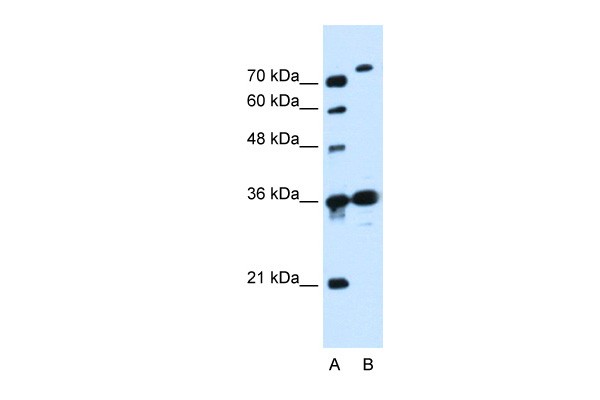
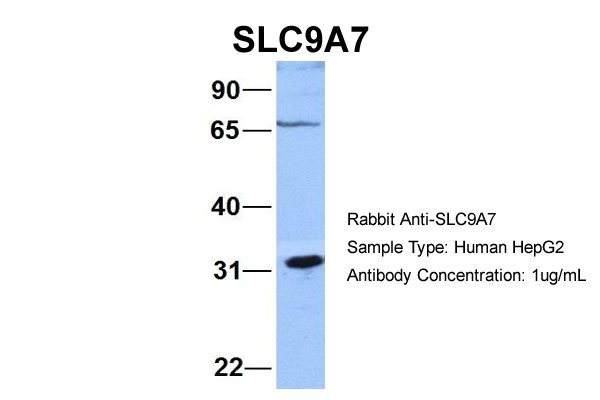
Western blot
0.2-1 ug/mlELISA Titer: 1:12500Positive Control: Jurkat cell lysateWestern blot
Host: Rabbit Target Name: EGFL8 Sample Tissue: HepG2 Antibody Dilution: 1.0ug/ml| Product Name | Rabbit anti-SLC9A7 polyclonal antibody - N-terminal region |
|---|---|
| Antibody Type | Primary Antibodies |
| Antigen Alias | NHE7, SLC9A6 |
| Immunogen | The immunogen for anti-SLC9A7 antibody: synthetic peptide directed towards the N terminal of human SLC9A7 |
| Clonality | Polyclonal |
|---|---|
| Isotype | IgG |
| Host Species | Rabbit |
| Tested Applications | WB |
| WB:1:500~1:2000 Notes:Optimal dilutions/concentrations should be determined by the researcher. |
|
| Species Reactivity | Guinea PigRatZebra Fish |
| Concentration | 1mg/ml |
| Purification | Affinity purified |
| Gene Symbol | SLC9A7 |
|---|---|
| Gene Synonyms | NHE7 SLC9A6 |
| Gene Full Name | Solute carrier family 9, subfamily A (NHE7, cation proton antiporter 7), member 7 |
| Gene Summary | Organelles of the secretory and endocytic pathways are distinguished by their luminal acidity, which is generated by the activity of an electrogenic vacuolar-type hydrogen ATPase. Progressive acidification of vesicles in the endocytic pathway is essential for the redistribution and degradation of internalized membrane proteins, such as ligand receptor complexes and fluid-phase solutes. It may play an important role in maintaining cation homeostasis and function of the trans-Golgi network.Organelles of the secretory and endocytic pathways are distinguished by their luminal acidity, which is generated by the activity of an electrogenic vacuolar-type hydrogen ATPase. Progressive acidification of vesicles in the endocytic pathway is essential for the redistribution and degradation of internalized membrane proteins, such as ligand receptor complexes and fluid-phase solutes. This gene is expressed predominantly in the trans-Golgi network, and mediates the influx of sodium or potassium in exchange for hydrogen. It may thus play an important role in maintaining cation homeostasis and function of the trans-Golgi network. This gene is part of a gene cluster on chromosome Xp11.23.Organelles of the secretory and endocytic pathways are distinguished by their luminal acidity, which is generated by the activity of an electrogenic vacuolar-type hydrogen ATPase. Progressive acidification of vesicles in the endocytic pathway is essential for the redistribution and degradation of internalized membrane proteins, such as ligand receptor complexes and fluid-phase solutes. This gene is expressed predominantly in the trans-Golgi network, and mediates the influx of sodium or potassium in exchange for hydrogen. It may thus play an important role in maintaining cation homeostasis and function of the trans-Golgi network. This gene is part of a gene cluster on chromosome Xp11.23. |
| Alternative Names | NHE7 SLC9A6 |
| Molecular Weight(MW) | 80kDa |
| Sequence | 725 amino acids |
Western blot
0.2-1 ug/mlELISA Titer: 1:12500Positive Control: Jurkat cell lysate
Western blot
Host: Rabbit Target Name: EGFL8 Sample Tissue: HepG2 Antibody Dilution: 1.0ug/ml| Application Notes | WB:1:500~1:2000 Notes:Optimal dilutions/concentrations should be determined by the researcher. |
|---|
| Form | Liquid |
|---|---|
| Storage Instructions | Aliquot and store at -20°C. Avoid repeated freeze / thaw cycles |
| Storage Buffer | phosphate buffered saline , pH 7.4, 150mM NaCl, 0.02% sodium azide and 50% glycerol. |


