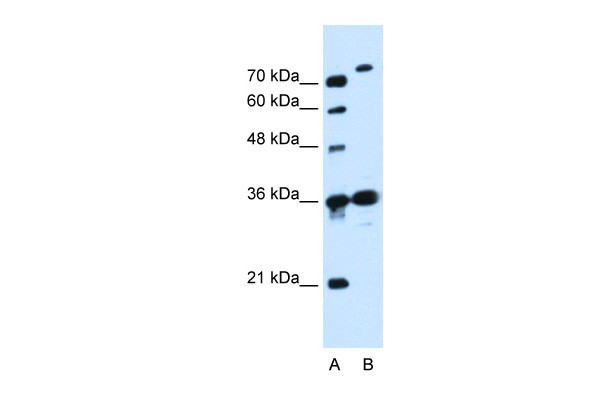
Application
Antibody used in WB on Human Jurkat 0.2-1 ug/ml.| Product Name | SLC9A7 Antibody |
|---|---|
| Antibody Type | Primary Antibodies |
| Antigen Alias | SLC9A7, NHE7, SLC9A6, NHE-7 |
| Product description | Organelles of the secretory and endocytic pathways are distinguished by their luminal acidity, which is generated by the activity of an electrogenic vacuolar-type hydrogen ATPase. Progressive acidification of vesicles in the endocytic pathway is essential for the redistribution and degradation of internalized membrane proteins, such as ligand receptor complexes and fluid-phase solutes. It may play an important role in maintaining cation homeostasis and function of the trans-Golgi network.Organelles of the secretory and endocytic pathways are distinguished by their luminal acidity, which is generated by the activity of an electrogenic vacuolar-type hydrogen ATPase. Progressive acidification of vesicles in the endocytic pathway is essential for the redistribution and degradation of internalized membrane proteins, such as ligand receptor complexes and fluid-phase solutes. This gene is expressed predominantly in the trans-Golgi network, and mediates the influx of sodium or potassium in exchange for hydrogen. It may thus play an important role in maintaining cation homeostasis and function of the trans-Golgi network. This gene is part of a gene cluster on chromosome Xp11.23.Organelles of the secretory and endocytic pathways are distinguished by their luminal acidity, which is generated by the activity of an electrogenic vacuolar-type hydrogen ATPase. Progressive acidification of vesicles in the endocytic pathway is essential for the redistribution and degradation of internalized membrane proteins, such as ligand receptor complexes and fluid-phase solutes. This gene is expressed predominantly in the trans-Golgi network, and mediates the influx of sodium or potassium in exchange for hydrogen. It may thus play an important role in maintaining cation homeostasis and function of the trans-Golgi network. This gene is part of a gene cluster on chromosome Xp11.23.1) Lin, P.J., J. Cell. Sci. 118 (PT 9), 1885-1897 (2005). |
| Immunogen | Antibody produced in rabbits immunized with a synthetic peptide corresponding a region of human SLC9A7. |
| Clonality | Polyclonal |
|---|---|
| Host Species | Rabbit |
| Tested Applications | ELISAWB |
| SLC9A7 antibody can be used for detection of SLC9A7 by ELISA at 1:312500. SLC9A7 antibody can be used for detection of SLC9A7 by western blot at 1 μg/mL, and HRP conjugated secondary antibody should be diluted 1:50,000 - 100,000.: |
|
| Species Reactivity | HumanMouse |
| Concentration | 1mg/ml |
| Purification | Affinity purified |
| Gene Symbol | SLC9A7 |
|---|---|
| Alternative Names | SLC9A7 NHE7 SLC9A6 NHE-7 |
| Molecular Weight(MW) | 80 kDa |
Application
Antibody used in WB on Human Jurkat 0.2-1 ug/ml.| Positive Control | 1) Cat. No. 1205 - Jurkat Cell Lysate |
|---|---|
| Application Notes | SLC9A7 antibody can be used for detection of SLC9A7 by ELISA at 1:312500. SLC9A7 antibody can be used for detection of SLC9A7 by western blot at 1 μg/mL, and HRP conjugated secondary antibody should be diluted 1:50,000 - 100,000.: |
| Form | Liquid |
|---|---|
| Storage Instructions | For short periods of storage (days) store at 4˚C. For longer periods of storage, store SLC9A7 antibody at -20˚C. As with any antibody avoid repeat freeze-thaw cycles. |
| Storage Buffer | Antibody is lyophilized in PBS buffer with 2% sucrose. Add 50 μL of distilled water. Final antibody concentration is 1 mg/mL. |


