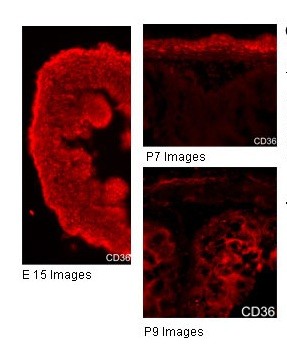
Immunofluorescence
ImmunofluorescenceWestern blot
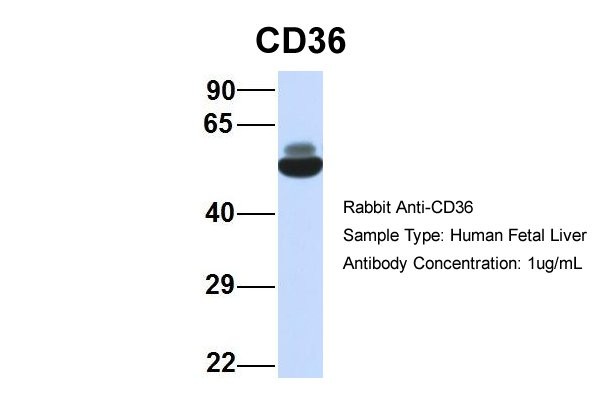
Host: Rabbit Target Name: CD36 Sample Tissue: Human Fetal Liver Antibody Dilution: 1.0ug/mlWestern blot
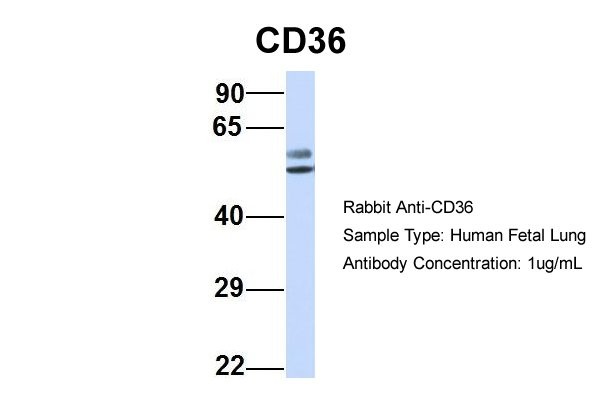
Host: Rabbit Target Name: CD36 Sample Tissue: Human Fetal Lung Antibody Dilution: 1.0ug/mlWestern blot
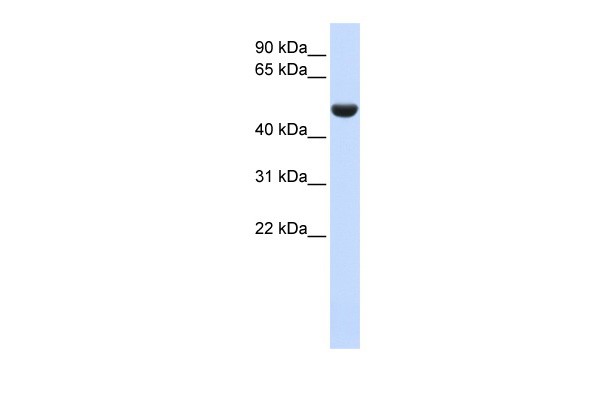
0.2-1 ug/mlELISA Titer: 1:62500Positive Control: Human LiveWestern blot
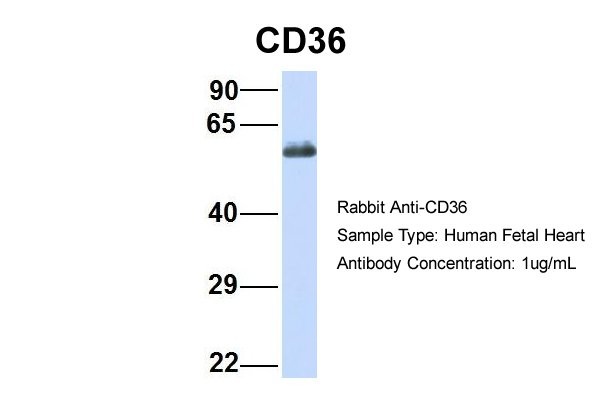
Host: Rabbit Target Name: CD36 Sample Tissue: Human Fetal Heart Antibody Dilution: 1.0ug/ml| Product Name | Rabbit anti-CD36 polyclonal antibody - N-terminal region |
|---|---|
| Antibody Type | Primary Antibodies |
| Antigen Alias | CHDS7, FAT, GP3B, GP4, GPIV, PASIV, SCARB3, BDPLT10 |
| Immunogen | The immunogen for anti-CD36 antibody: synthetic peptide directed towards the N terminal of human CD36 |
| Clonality | Polyclonal |
|---|---|
| Isotype | IgG |
| Host Species | Rabbit |
| Tested Applications | IHCWB |
| IHC:1:50~1:200 WB:1:500~1:2000 Notes:Optimal dilutions/concentrations should be determined by the researcher. |
|
| Species Reactivity | BovineDogGoatGuinea PigHumanMousePigRabbitRat |
| Concentration | 1mg/ml |
| Purification | Affinity purified |
| Gene Symbol | CD36 |
|---|---|
| Gene Synonyms | CHDS7 FAT GP3B GP4 GPIV PASIV SCARB3 BDPLT10 |
| Gene Full Name | CD36 molecule (thrombospondin receptor) |
| Gene Summary | CD36 is the fourth major glycoprotein of the platelet surface and serves as a receptor for thrombospondin in platelets and various cell lines. Since thrombospondins are widely distributed proteins involved in a variety of adhesive processes, this protein may have important functions as a cell adhesion molecule. It binds to collagen, thrombospondin, anionic phospholipids and oxidized LDL. It directly mediates cytoadherence of Plasmodium falciparum parasitized erythrocytes and it binds long chain fatty acids and may function in the transport and/or as a regulator of fatty acid transport. Mutations in its gene cause platelet glycoprotein deficiency. The protein encoded by this gene is the fourth major glycoprotein of the platelet surface and serves as a receptor for thrombospondin in platelets and various cell lines. Since thrombospondins are widely distributed proteins involved in a variety of adhesive processes, this protein may have important functions as a cell adhesion molecule. It binds to collagen, thrombospondin, anionic phospholipids and oxidized LDL. It directly mediates cytoadherence of Plasmodium falciparum parasitized erythrocytes and it binds long chain fatty acids and may function in the transport and/or as a regulator of fatty acid transport. Mutations in this gene cause platelet glycoprotein deficiency. Multiple alternatively spliced transcript variants encoding the same protein have been found for this gene. |
| Alternative Names | CHDS7 FAT GP3B GP4 GPIV PASIV SCARB3 BDPLT10 |
| Molecular Weight(MW) | 53kDa |
| Sequence | KTIKKQVVLEEGTIAFKNWVKTGTEVYRQFWIFDVQNPQEVMMNSSNIQV |
| Entrez Gene | 948 |
|---|---|
| SwissProt ID | P16671 |
| Protein Accession | NP_001001547 |
Immunofluorescence
Immunofluorescence
Western blot
Host: Rabbit Target Name: CD36 Sample Tissue: Human Fetal Liver Antibody Dilution: 1.0ug/ml
Western blot
Host: Rabbit Target Name: CD36 Sample Tissue: Human Fetal Lung Antibody Dilution: 1.0ug/ml
Western blot
0.2-1 ug/mlELISA Titer: 1:62500Positive Control: Human Live
Western blot
Host: Rabbit Target Name: CD36 Sample Tissue: Human Fetal Heart Antibody Dilution: 1.0ug/ml| Application Notes | IHC:1:50~1:200 WB:1:500~1:2000 Notes:Optimal dilutions/concentrations should be determined by the researcher. |
|---|
| Form | Liquid |
|---|---|
| Storage Instructions | Aliquot and store at -20°C. Avoid repeated freeze / thaw cycles |
| Storage Buffer | phosphate buffered saline , pH 7.4, 150mM NaCl, 0.02% sodium azide and 50% glycerol. |


