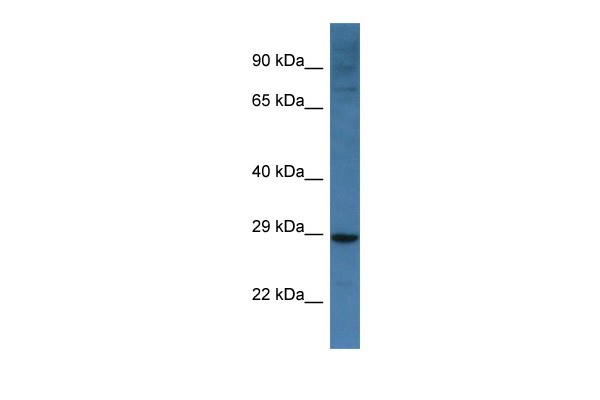
Western blot
Titration: 1.0 ug/mlPositive Control: Mouse Spleen| Product Name | Rabbit anti-Bnip3l polyclonal antibody - middle region |
|---|---|
| Antibody Type | Primary Antibodies |
| Antigen Alias | C86132, D14Ertd719e, Nip3L, Nix |
| Clonality | Polyclonal |
|---|---|
| Isotype | IgG |
| Host Species | Rabbit |
| Tested Applications | WB |
| WB:1:500~1:2000 Notes:Optimal dilutions/concentrations should be determined by the researcher. |
|
| Species Reactivity | DogGuinea PigHumanMousePigRat |
| Concentration | 1mg/ml |
| Purification | Affinity purified |
| Gene Symbol | Bnip3l |
|---|---|
| Gene Synonyms | C86132 D14Ertd719e Nip3L Nix |
| Gene Full Name | BCL2/adenovirus E1B interacting protein 3-like |
| Gene Summary | Bnip3l induces apoptosis. It interacts with viral and cellular anti-apoptosis proteins. It can overcome the suppressors BCL-2 and BCL-XL, although high levels of BCL-XL expression will inhibit apoptosis. It inhibits apoptosis induced by BNIP3. It is involved in mitochondrial quality control via its interaction with SPATA18/MIEAP: in response to mitochondrial damage, participates to mitochondrial protein catabolic process (also named MALM) leading to the degradation of damaged proteins inside mitochondria. Bnip3l may function as a tumor suppressor. |
| Alternative Names | C86132 D14Ertd719e Nip3L Nix |
| Molecular Weight(MW) | 24kDa |
| Sequence | 218 amino acids |
Western blot
Titration: 1.0 ug/mlPositive Control: Mouse Spleen| Application Notes | WB:1:500~1:2000 Notes:Optimal dilutions/concentrations should be determined by the researcher. |
|---|
| Form | Liquid |
|---|---|
| Storage Instructions | Aliquot and store at -20°C. Avoid repeated freeze / thaw cycles |
| Storage Buffer | phosphate buffered saline , pH 7.4, 150mM NaCl, 0.02% sodium azide and 50% glycerol. |


