Application
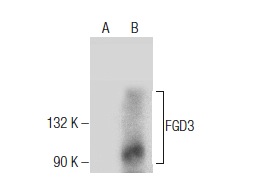
Western blot analysis of FGD3 expression in non-transfected: (A) and human FGD3 transfected: (B) 293T whole cell lysates.| Product Name | FGD3 Antibody (M-101) |
|---|---|
| Antibody Type | Primary Antibodies |
| Antigen Alias | epitope corresponding to amino acids 73-173 mapping near the N-terminus of FGD3 of mouse origin |
| Modification Notes | FGD1 gene mutations result in faciogenital dysplasia (FGDY, Aarskog-Scott syndrome), an X-linked developmental disorder that adversely affects the formation of multiple skeletal structures. FGD1 maps to human chromosome Xp11.21 and shares a high degree of sequence identity with the FGD2 (6p21.2) and the FGD3 (9q22.31) proteins. FGD1 encodes a guanine nucleotide exchange factor that specifically activates the Rho GTPase Cdc42. FGD2 is present in several diverse tissues during embryogenesis, suggesting a role in embryonic development. FGD3 stimulates fibroblasts to form filopodia, which are Actin microspikes formed upon the stimulation of Cdc42. All FGD family members contain equivalent signaling domains and a conserved structural organization, which strongly suggests that these signaling domains form a canonical core structure for members of the FGD family of RhoGEF proteins. These proteins control essential signals required during embryonic development. |
| Clonality | Polyclonal |
|---|---|
| Isotype | IgG |
| Host Species | Rabbit |
| Tested Applications | WBIPIFELISA |
| recommended for detection of FGD3 of mouse, rat and human origin by WB, IP, IF and ELISA: |
|
| Species Reactivity | HumanMouseRat |
| Concentration | 1mg/ml |
| Purification | Affinity purified |
| Alternative Names | epitope corresponding to amino acids 73-173 mapping near the N-terminus of FGD3 of mouse origin |
|---|---|
| Tissue Specificity | epitope corresponding to amino acids 73-173 mapping near the N-terminus of FGD3 of mouse origin |
| Entrez Gene | 89846 |
|---|
Application
Western blot analysis of FGD3 expression in non-transfected: (A) and human FGD3 transfected: (B) 293T whole cell lysates.| Application Notes | recommended for detection of FGD3 of mouse, rat and human origin by WB, IP, IF and ELISA: |
|---|
| Form | Liquid |
|---|---|
| Storage Instructions | For short-term storage, store at 4° C. For long-term storage, aliquot and store at -20ºC or below. Avoid multiple freeze-thaw cycles. |
| Storage Buffer | phosphate buffered saline , pH 7.4, 150mM NaCl, 0.02% sodium azide and 50% glycerol. |


