Application
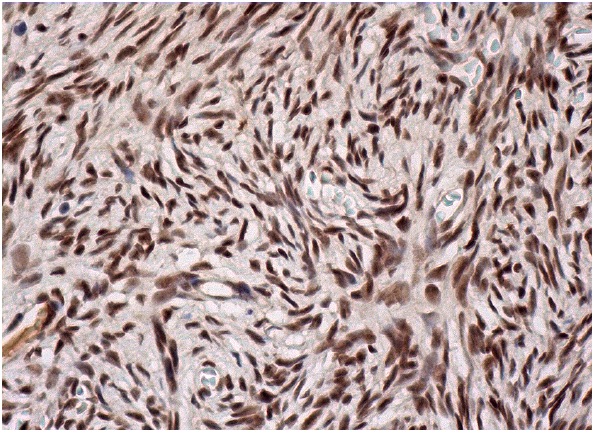
Immunoperoxidase staining of formalin fixed, paraffin-embedded human ovary tissue showing nuclear staining of follicle cells.Application
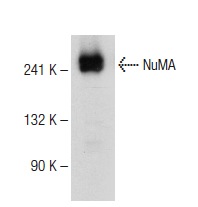
Western blot analysis of NuMA expression in MOLT-4 nuclear extract.| Product Name | NuMA Antibody (H-300) |
|---|---|
| Antibody Type | Primary Antibodies |
| Antigen Alias | epitope corresponding to amino acids 1816-2115 mapping at the C-terminus of NuMA of human origin |
| Modification Notes | There are a multitude of structural components in the nucleus that sustain proper structure and function relationships with respect to nuclear assembly and mitosis. The human nuclear mitotic apparatus protein gene, also designated NuMA, maps to chromosome 11q13 and encodes a noncentrosomal protein (1,2). NuMA possesses microtubule (MT) binding capacity via its carboxyl terminal region and is involved in spindle pole organization (3,4). NuMA is essential for the organization and stabilization of spindle poles from early mitosis until at least the onset of anaphase (4). During interphase, NuMA is present throughout the nucleus and upon entering mitosis, localizes to the spindle apparatus (5). During mitosis, NuMA forms aggregates that interact with microtubules and certain motor proteins and as a result may draw together the minus-ends of microtubules, thereby helping to organize them into a bipolar spindle (6). In contrast to mitotic cells, post-mitotic neurons display NuMA both in the nucleus and in the cytoplasm (6). Elevated levels of NuMA expression have been reported in cancer patients, particularly in colorectal carcinoma and early colorectal cancers (7). |
| Clonality | Polyclonal |
|---|---|
| Isotype | IgG |
| Host Species | Rabbit |
| Tested Applications | WBIPIFIHCELISA |
| recommended for detection of NuMA of mouse, rat and human origin by WB, IP, IF, IHC(P) and ELISA also reactive with additional species, including equine, bovine and porcine: |
|
| Species Reactivity | HumanMouseRat |
| Concentration | 1mg/ml |
| Purification | Affinity purified |
| Alternative Names | epitope corresponding to amino acids 1816-2115 mapping at the C-terminus of NuMA of human origin |
|---|---|
| Tissue Specificity | epitope corresponding to amino acids 1816-2115 mapping at the C-terminus of NuMA of human origin |
| Entrez Gene | 4926 |
|---|
Application
Immunoperoxidase staining of formalin fixed, paraffin-embedded human ovary tissue showing nuclear staining of follicle cells.
Application
Western blot analysis of NuMA expression in MOLT-4 nuclear extract.| Application Notes | recommended for detection of NuMA of mouse, rat and human origin by WB, IP, IF, IHC(P) and ELISA also reactive with additional species, including equine, bovine and porcine: |
|---|
| Form | Liquid |
|---|---|
| Storage Instructions | For short-term storage, store at 4° C. For long-term storage, aliquot and store at -20ºC or below. Avoid multiple freeze-thaw cycles. |
| Storage Buffer | phosphate buffered saline , pH 7.4, 150mM NaCl, 0.02% sodium azide and 50% glycerol. |


