Application
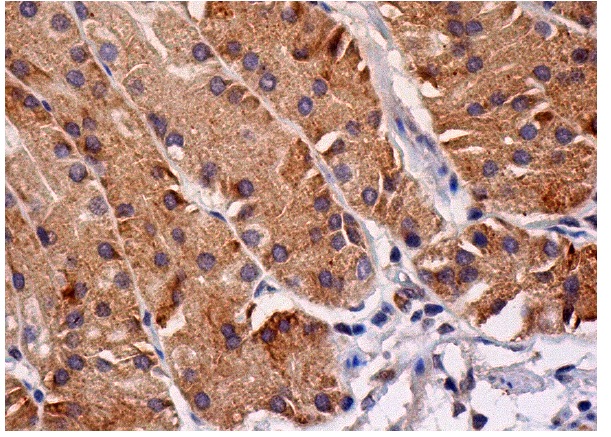
Immunoperoxidase staining of formalin fixed, paraffin-embedded human stomach tissue showing cytoplasmic staining of glandular cells.| Product Name | Pendrin Antibody (H-195) |
|---|---|
| Antibody Type | Primary Antibodies |
| Antigen Alias | epitope corresponding to amino acids 586-780 mapping at the C-terminus of Pendrin of human origin |
| Modification Notes | Pendred syndrome (PDS), an autosomal recessive disorder, is the most common form of syndromic deafness characterized by congenital sensorineural hearing loss and goiter. The gene associated with PDS is mapped to chromosome 7 and encodes a putative transmembrane protein designated Pendrin. Several mutations in the gene have been identified and account for about 10% of hereditary deafness. Pendrin transcripts are expressed at significant levels in the thyroid, inner ear, fetal cochlea and kidney, but expression is drastically reduced in thyroid carcinomas. Pendrin functions as a transporter of chloride and iodide, but not sulfate, in these tissues. Pendrin is an apical anion transporter in intercalated cells of proximal tubule and cortical collecting ducts, which mediate renal bicarbonate secretion and Cl-/OH-, Cl-/HCO3- and Cl-/formate exchange in kidney. Pendrin is expressed throughout the endo-lymphatic duct and sac in distinct areas of the utricle and saccule and in the external sulcus region within the cochlea, where it plays a role in the development of ion gradients. |
| Clonality | Polyclonal |
|---|---|
| Isotype | IgG |
| Host Species | Rabbit |
| Tested Applications | WBIPIFIHCELISA |
| recommended for detection of Pendrin of mouse, rat and human origin by WB, IP, IF, IHC(P) and ELISA also reactive with additional species, including canine, bovine and porcine: |
|
| Species Reactivity | HumanMouseRat |
| Concentration | 1mg/ml |
| Purification | Affinity purified |
| Alternative Names | epitope corresponding to amino acids 586-780 mapping at the C-terminus of Pendrin of human origin |
|---|---|
| Tissue Specificity | epitope corresponding to amino acids 586-780 mapping at the C-terminus of Pendrin of human origin |
| Entrez Gene | 5172 |
|---|
Application
Immunoperoxidase staining of formalin fixed, paraffin-embedded human stomach tissue showing cytoplasmic staining of glandular cells.| Application Notes | recommended for detection of Pendrin of mouse, rat and human origin by WB, IP, IF, IHC(P) and ELISA also reactive with additional species, including canine, bovine and porcine: |
|---|
| Form | Liquid |
|---|---|
| Storage Instructions | For short-term storage, store at 4° C. For long-term storage, aliquot and store at -20ºC or below. Avoid multiple freeze-thaw cycles. |
| Storage Buffer | phosphate buffered saline , pH 7.4, 150mM NaCl, 0.02% sodium azide and 50% glycerol. |


