Application
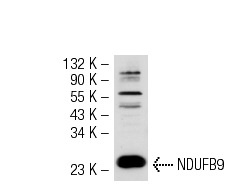
Western blot analysis of NDUFB9 expression in Ramos whole cell lysate.| Product Name | NDUFB9 Antibody (C-14) |
|---|---|
| Antibody Type | Primary Antibodies |
| Antigen Alias | epitope mapping near the C-terminus of NDUFB9 of human origin |
| Modification Notes | NDUFB9 (NADH dehydrogenase (ubiquinone) 1 beta subcomplex, 9), also known as LYRM3 or B22, is a 179 amino acid protein that belongs to the complex I LYR family. Localized to the inner mitochondrial membrane, as well as to the matrix side of the peripheral membrane, NDUFB9 functions as an accessory subunit of the multi-subunit mitochondrial membrane respiratory chain NADH dehydrogenase complex I. Complex I plays an important role in the transfer of electrons from NADH to the respiratory chain, a process that is essential for cellular respiration. The gene encoding NDUFB9 maps to human chromosome 8, which consists of nearly 146 million base pairs, houses more than 800 genes and is associated with a variety of diseases and malignancies. Schizophrenia, bipolar disorder, Trisomy 8, Pfeiffer syndrome, congenital hypothyroidism, Waardenburg syndrome and some leukemias and lymphomas are thought to occur as a result of defects in specific genes that map to chromosome 8. |
| Clonality | Polyclonal |
|---|---|
| Isotype | IgG |
| Host Species | Rabbit |
| Tested Applications | WBIPIFELISA |
| recommended for detection of NDUFB9 of h and r origin by WB, IP, IF and ELISA non cross-reactive with NDUFB4 or NDUFB5 also reactive with additional species, including equine and bovine: |
|
| Species Reactivity | HumanMouseRat |
| Concentration | 1mg/ml |
| Purification | Affinity purified |
| Alternative Names | epitope mapping near the C-terminus of NDUFB9 of human origin |
|---|---|
| Tissue Specificity | epitope mapping near the C-terminus of NDUFB9 of human origin |
| Entrez Gene | 4715 |
|---|
Application
Western blot analysis of NDUFB9 expression in Ramos whole cell lysate.| Application Notes | recommended for detection of NDUFB9 of h and r origin by WB, IP, IF and ELISA non cross-reactive with NDUFB4 or NDUFB5 also reactive with additional species, including equine and bovine: |
|---|
| Form | Liquid |
|---|---|
| Storage Instructions | For short-term storage, store at 4° C. For long-term storage, aliquot and store at -20ºC or below. Avoid multiple freeze-thaw cycles. |
| Storage Buffer | phosphate buffered saline , pH 7.4, 150mM NaCl, 0.02% sodium azide and 50% glycerol. |


