Application
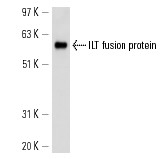
Western blot analysis of human recombinant ILT fusion protein.| Product Name | ILT Antibody (H-300) |
|---|---|
| Antibody Type | Primary Antibodies |
| Antigen Alias | epitope corresponding to amino acids 162-461 mapping within an extracellular domain of ILT-2 of human origin |
| Modification Notes | Leukocyte immunoglobulin-like receptors (ILTs, also known as LIRs) are members of the immunoglobulin superfamily of glycoproteins and are predominantly expressed by monocytes, B cells, dendritic cells, natural killer (NK) cells, peripheral blood leukocytes and tissues such as placenta, lung and liver. There are several members of the ILT family, including ILT-1, ILT-2, ILT-3, ILT-4, ILT-5, ILT-6, ILT-7, ILT-8, ILT-11, LIR-6 and LIR-8. These ILT proteins are divided into two subfamiles, namely subfamily A (ILT-1, ILT-6, ILT-7, ILT-8, ILT-11 and LIR-6) and subfamily B (ILT-2, ILT-3, ILT-4, ILT-5 and LIR-8), the former of which function as stimulating receptors and the latter of which function as inhibitory receptors. Characteristically, members of subfamily A have transmembrane regions containing a charged arginine residue through which they initiate stimulatory cascades, while members of subfamily B contain cytoplasmic immunoreceptor tyrosine-based inhibitory motifs (ITIMs) through which they induce inhibitory signaling cascades. |
| Clonality | Polyclonal |
|---|---|
| Isotype | IgG |
| Host Species | Rabbit |
| Tested Applications | WBIPIFELISA |
| recommended for detection of ILT famiy members 1,2,4,5 and 6 of human origin by WB, IP, IF and ELISA: |
|
| Species Reactivity | HumanMouseRat |
| Concentration | 1mg/ml |
| Purification | Affinity purified |
| Alternative Names | epitope corresponding to amino acids 162-461 mapping within an extracellular domain of ILT-2 of human origin |
|---|---|
| Tissue Specificity | epitope corresponding to amino acids 162-461 mapping within an extracellular domain of ILT-2 of human origin |
| Entrez Gene | 10859 |
|---|
Application
Western blot analysis of human recombinant ILT fusion protein.| Application Notes | recommended for detection of ILT famiy members 1,2,4,5 and 6 of human origin by WB, IP, IF and ELISA: |
|---|
| Form | Liquid |
|---|---|
| Storage Instructions | For short-term storage, store at 4° C. For long-term storage, aliquot and store at -20ºC or below. Avoid multiple freeze-thaw cycles. |
| Storage Buffer | phosphate buffered saline , pH 7.4, 150mM NaCl, 0.02% sodium azide and 50% glycerol. |


