Application
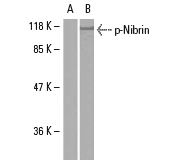
Antibodies tested include p-Nibrin (Ser 343): preincubated with cognate phosphorylated peptide (A) and p-Nibrin (Ser 343): (B).| Product Name | p-Nibrin Antibody (Ser 343) |
|---|---|
| Antibody Type | Primary Antibodies |
| Antigen Alias | epitope corresponding to phosphorylated Ser 343 of Nibrin of human origin |
| Modification | Phosphoralated |
| Modification Notes | Nijmegen breakage syndrome (NBS) is characterized by extreme radiation sensitivity, chromosomal instability and cancer (1). These phenotypes are similar to those of ataxia telangiectasia mutated (ATM) disease, where there is a deficiency in a protein kinase that is activated by DNA damage, indicating that the NBS1 (Nibrin) and ATM proteins may participate in common pathways (1). Nibrin is specifically phosphorylated in response to gamma-radiation, ultraviolet light and exposure to hydroxyurea (1). The phosphorylation of Nibrin requires catalytically active ATM (2). ATM physically interacts with and phosphorylates Nibrin on Serine 343 both in vitro and in vivo (3). Serine 343 is phosphorylated in vitro by ATM and the modification of this residue in vivo is essential for the cellular response to DNA damage (2–4). This response includes S-phase checkpoint activation, formation of the NBS1/Mrel1/Rad50 nuclear foci and rescue of hypersensitivity to ionizing radiation (2,5). |
| Clonality | Polyclonal |
|---|---|
| Isotype | IgG |
| Host Species | Rabbit |
| Tested Applications | WBIP |
| recommended for detection of Ser 343 phosphorylated Nibrin of h origin by WB and IP: |
|
| Species Reactivity | HumanMouseRat |
| Concentration | 1mg/ml |
| Purification | Affinity purified |
| Alternative Names | epitope corresponding to phosphorylated Ser 343 of Nibrin of human origin |
|---|---|
| Tissue Specificity | epitope corresponding to phosphorylated Ser 343 of Nibrin of human origin |
| Entrez Gene | 4683 |
|---|
Application
Antibodies tested include p-Nibrin (Ser 343): preincubated with cognate phosphorylated peptide (A) and p-Nibrin (Ser 343): (B).| Application Notes | recommended for detection of Ser 343 phosphorylated Nibrin of h origin by WB and IP: |
|---|
| Form | Liquid |
|---|---|
| Storage Instructions | For short-term storage, store at 4° C. For long-term storage, aliquot and store at -20ºC or below. Avoid multiple freeze-thaw cycles. |
| Storage Buffer | phosphate buffered saline , pH 7.4, 150mM NaCl, 0.02% sodium azide and 50% glycerol. |


