Application
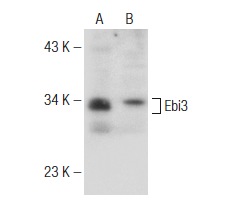
Western blot analysis of Ebi3 expression in I-11.15 (A) and Hep G2 (B) whole cell lysates.Application
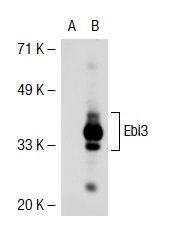
Western blot analysis of Ebi3 expression in non-transfected: (A) and mouse Ebi3 transfected: (B) 293T whole cell lysates.| Product Name | Ebi3 Antibody (M-75) |
|---|---|
| Antibody Type | Primary Antibodies |
| Antigen Alias | epitope corresponding to amino acids 154-228 mapping at the C-terminus of Ebi3 of mouse origin |
| Modification Notes | Epstein-Barr virus-induced gene 3 (Ebi3) is a widely expressed homolog to the interleukin IL-12 p40 subunit protein that forms a heterodimer with either IL-12 p35 or an IL-12 p35 homolog, p28, to create a new cytokine (IL-27). IL-27 is an early product of activated antigen-presenting cells and drives rapid clonal expansion of naive but not memory CD4+ T cells. Interferon-b differentially regulates expression of the IL-12 family members p35, p40, p19 and Ebi3 in activated human dendritic cells. Ebi3 may function to antagonize IL-12 and to inhibit the development of a Th1 immune response. Ebi3 is strongly expressed in Hodgkin and Reed-Sternberg cells, independently of the EBV status of the tumor cells. Research suggests that Ebi3 may be an additional component of the repertoire employed by Hodgkin and Reed-Sternberg cells to inhibit an effective anti-tumor or anti-viral immune response. The human Ebi3 gene maps to chromosome 19p13.3 and encodes a secreted glycoprotein that is expressed in spleen and tonsils, and at high levels in full-term placenta. |
| Clonality | Polyclonal |
|---|---|
| Isotype | IgG |
| Host Species | Rabbit |
| Tested Applications | WBIPIFELISA |
| recommended for detection of Ebi3 of mouse, rat and, to a lesser extent, human origin by WB, IP, IF and ELISA: |
|
| Species Reactivity | HumanMouseRat |
| Concentration | 1mg/ml |
| Purification | Affinity purified |
| Alternative Names | epitope corresponding to amino acids 154-228 mapping at the C-terminus of Ebi3 of mouse origin |
|---|---|
| Tissue Specificity | epitope corresponding to amino acids 154-228 mapping at the C-terminus of Ebi3 of mouse origin |
| Entrez Gene | 10148 |
|---|
Application
Western blot analysis of Ebi3 expression in I-11.15 (A) and Hep G2 (B) whole cell lysates.
Application
Western blot analysis of Ebi3 expression in non-transfected: (A) and mouse Ebi3 transfected: (B) 293T whole cell lysates.| Application Notes | recommended for detection of Ebi3 of mouse, rat and, to a lesser extent, human origin by WB, IP, IF and ELISA: |
|---|
| Form | Liquid |
|---|---|
| Storage Instructions | For short-term storage, store at 4° C. For long-term storage, aliquot and store at -20ºC or below. Avoid multiple freeze-thaw cycles. |
| Storage Buffer | phosphate buffered saline , pH 7.4, 150mM NaCl, 0.02% sodium azide and 50% glycerol. |


