Application
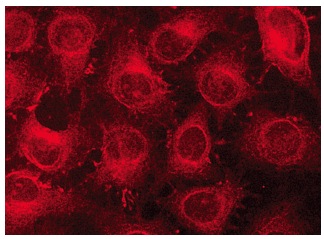
Immunofluorescence staining of methanol-fixed HeLa cells showing cytoplasmic localization.Application
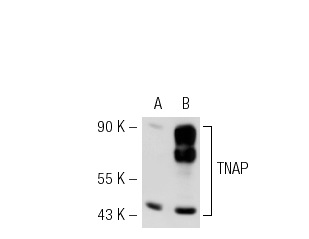
Western blot analysis of TNAP expression in non-transfected: (A) and human TNAP transfected: (B) 293T whole cell lysates.| Product Name | Alkaline Phosphatase Antibody (H-300) |
|---|---|
| Antibody Type | Primary Antibodies |
| Antigen Alias | epitope corresponding to amino acids 18-317 mapping near the N-terminus of TNAP of human origin |
| Modification Notes | Alkaline phosphatases (AP) are glycosyl-phosphatidylinositol (GPI)-anchored, dimeric, Zn2+ metallated glycoproteins that catalyze the hydrolysis of phosphomonoesters into an inorganic phosphate and an alcohol. They are most effective in an alkaline environment and specifically function to remove phosphate groups in the 5- and 3- positions from many types of molecules, including nucleotides, proteins and alkaloids. There are at least four distinct but related alkaline phosphatases: intestinal (IAP), placental (PLAP), placental-like (ALP-1 or GCAP) and tissue non-specific (TNAP). The first three are located together on chromosome 2 while the tissue non-specific form is located on chromosome 1. Alkaline phosphatases have become useful tools in molecular biology laboratories, removing the phosphate groups on the 5’ end of DNA. Removal of these phosphates prevents the DNA from ligating, thereby preventing DNA degradation. In addition, alkaline phosphatases can also be used as a label for enzyme immunoassays. |
| Clonality | Polyclonal |
|---|---|
| Isotype | IgG |
| Host Species | Rabbit |
| Tested Applications | WBIPIFELISA |
| recommended for detection of TNAP of mouse, rat and human origin and, to a lesser extent, PLAP, ALPPL2 and IAP of human origin and Akp-3, Akp-5 and Akp-6 of mouse and rat origin by WB, IP, IF and ELISA partially cross-reactive with other alkaline phosphatases also reactive with additional species, including equine, canine and bovine: |
|
| Species Reactivity | HumanMouseRat |
| Concentration | 1mg/ml |
| Purification | Affinity purified |
| Alternative Names | epitope corresponding to amino acids 18-317 mapping near the N-terminus of TNAP of human origin |
|---|---|
| Tissue Specificity | epitope corresponding to amino acids 18-317 mapping near the N-terminus of TNAP of human origin |
| Entrez Gene | 249 |
|---|
Application
Immunofluorescence staining of methanol-fixed HeLa cells showing cytoplasmic localization.
Application
Western blot analysis of TNAP expression in non-transfected: (A) and human TNAP transfected: (B) 293T whole cell lysates.| Application Notes | recommended for detection of TNAP of mouse, rat and human origin and, to a lesser extent, PLAP, ALPPL2 and IAP of human origin and Akp-3, Akp-5 and Akp-6 of mouse and rat origin by WB, IP, IF and ELISA partially cross-reactive with other alkaline phosphatases also reactive with additional species, including equine, canine and bovine: |
|---|
| Form | Liquid |
|---|---|
| Storage Instructions | For short-term storage, store at 4° C. For long-term storage, aliquot and store at -20ºC or below. Avoid multiple freeze-thaw cycles. |
| Storage Buffer | phosphate buffered saline , pH 7.4, 150mM NaCl, 0.02% sodium azide and 50% glycerol. |


