Application
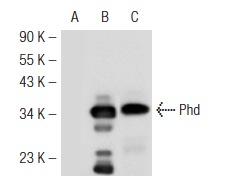
Western blot analysis of Phd expression in non-transfected: (A) and mouse Phd transfected: (B) 293T whole cell lysates and rat eye tissue extract (C).| Product Name | Phd Antibody (H-110) |
|---|---|
| Antibody Type | Primary Antibodies |
| Antigen Alias | epitope corresponding to amino acids 31-140 mapping within an internal region of Phosducin (Phd) of human origin |
| Modification Notes | Phosducin is a phototransducing protein that may participate in the feedback regulation of visual phototransduction or in the integration of photoreceptor metabolism. The human phosducin gene maps to chromosome 1q25-q31.1 and encodes a 246 amino acid protein, also designated Phd. Phd is primarily expressed in the retina and the pineal gland, while lower levels are present in tissues such as liver, spleen, striated muscle and the brain. Retinal Phd is found exclusively in the outer and inner segments of photoreceptor cells, including the synaptic and nuclear layers. Phd modulates the phototransduction cascade through high affinity binding and sequestration of G beta/gamma subunits of heterotrimeric G proteins. Neutralization of G beta/gamma by phosducin inhibits G protein-mediated signaling, since G alpha is unable to reassemble with G beta/gamma and provide a functional G protein trimer (G alpha/beta/gamma). In addition, phosducin can effectively slow down the mechanism of internalization of G protein-coupled opioid receptors. |
| Clonality | Polyclonal |
|---|---|
| Isotype | IgG |
| Host Species | Rabbit |
| Tested Applications | WBIPIFELISA |
| recommended for detection of Phd of mouse, rat and human origin by WB, IP, IF and ELISA also reactive with additional species, including equine, canine, bovine and porcine: |
|
| Species Reactivity | HumanMouseRat |
| Concentration | 1mg/ml |
| Purification | Affinity purified |
| Alternative Names | epitope corresponding to amino acids 31-140 mapping within an internal region of Phosducin (Phd) of human origin |
|---|---|
| Tissue Specificity | epitope corresponding to amino acids 31-140 mapping within an internal region of Phosducin (Phd) of human origin |
| Entrez Gene | 5132 |
|---|
Application
Western blot analysis of Phd expression in non-transfected: (A) and mouse Phd transfected: (B) 293T whole cell lysates and rat eye tissue extract (C).| Application Notes | recommended for detection of Phd of mouse, rat and human origin by WB, IP, IF and ELISA also reactive with additional species, including equine, canine, bovine and porcine: |
|---|
| Form | Liquid |
|---|---|
| Storage Instructions | For short-term storage, store at 4° C. For long-term storage, aliquot and store at -20ºC or below. Avoid multiple freeze-thaw cycles. |
| Storage Buffer | phosphate buffered saline , pH 7.4, 150mM NaCl, 0.02% sodium azide and 50% glycerol. |


