Application
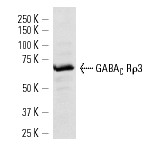
Western blot analysis of GABAC Rρ3 expression in rat testis tissue extract.| Product Name | GABAC Rρ3 Antibody (R-110) |
|---|---|
| Antibody Type | Primary Antibodies |
| Antigen Alias | epitope corresponding to amino acids 355-464 mapping at the C-terminus of GABAC Rρ3 of rat origin |
| Modification Notes | GAD-65 and GAD-67, glutamate decarboxylases, function to catalyze the production of GABA (gamma-aminobutyric acid). In the central nervous system GABA functions as the main inhibitory transmitter by increasing a Cl- conductance that inhibits neuronal firing. GABA has been shown to activate both ionotropic (GABAA) and metabotropic (GABAB) receptors as well as a third class of receptors called GABAC. Both GABAA and GABAC are ligand-gated ion channels; however, they are structurally and functionally distinct. GABAC receptors (GABAC Rr) mediate rapid inhibitory neurotransmission in retina. Three human genes, r1 (GABRR1), r2 (GABRR2) and r3 (GABRR3), encode the three polypeptides that comprise this receptor. GABRR1 and GABRR2 are located close together, in a region of chromosome 6q that contains loci for inherited disorders of the eye, but GABRR3 maps to chromosome 3q11-q13.3. The r polypeptide genes, which are thought to share a common ancestor with GABA(A) receptor subunit genes, diverged at an early stage in the evolution of this gene family. The expression of GABAC Rr subunits is not restricted to the retina, but significant expression can also be detected in many other brain regions, especially in those belonging to the visual pathways. |
| Clonality | Polyclonal |
|---|---|
| Isotype | IgG |
| Host Species | Rabbit |
| Tested Applications | WBIPIFELISA |
| recommended for detection of GABAC Rρ3 of mouse and rat origin by WB, IP, IF and ELISA: |
|
| Species Reactivity | HumanMouseRat |
| Concentration | 1mg/ml |
| Purification | Affinity purified |
| Alternative Names | epitope corresponding to amino acids 355-464 mapping at the C-terminus of GABAC R&rho 3 of rat origin |
|---|---|
| Tissue Specificity | epitope corresponding to amino acids 355-464 mapping at the C-terminus of GABAC Rρ3 of rat origin |
| Entrez Gene | 328699 |
|---|
Application
Western blot analysis of GABAC Rρ3 expression in rat testis tissue extract.| Application Notes | recommended for detection of GABAC Rρ3 of mouse and rat origin by WB, IP, IF and ELISA: |
|---|
| Form | Liquid |
|---|---|
| Storage Instructions | For short-term storage, store at 4° C. For long-term storage, aliquot and store at -20ºC or below. Avoid multiple freeze-thaw cycles. |
| Storage Buffer | phosphate buffered saline , pH 7.4, 150mM NaCl, 0.02% sodium azide and 50% glycerol. |


