Application
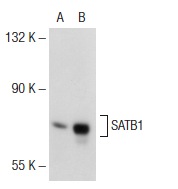
Western blot analysis of SATB1 expression in non-transfected: (A) and human SATB1 transfected: (B) 293T whole cell lysates.| Product Name | SATB1 Antibody (H-70) |
|---|---|
| Antibody Type | Primary Antibodies |
| Antigen Alias | epitope corresponding to amino acids 241-310 mapping within an internal region of SATB1 of human origin |
| Modification Notes | The homeoproteins CCAAT displacement protein (CDP) and special AT-rich sequence binding protein 1 (SATB1) are transcriptional repressors of many cellular genes, and they participate in cell development and cell type differentiation. SATB1 is expressed primarily in thymocytes, and, like CDP, it also contains a distinct homeobox DNA-binding domain that is essential for DNA binding. SATB1 and CDP interact through these homeodomains and synergistically function as mediators of gene expression. SATB1 contains an additional domain that has a higher affinity for DNA and specifically facilitates the direct association between SATB1 and the nuclear matrix attachment regions (MARs) of DNA. MARs are specific DNA sequences that bind to the nuclear matrix and form the base of chromosomal loops that organize the chromosomes and regulate DNA transcription and replication within the nucleus. The association of SATB1 with the core unwinding element within the base-unpairing region of MARs requires both the MAR and homeobox binding domains of SATB1. |
| Clonality | Polyclonal |
|---|---|
| Isotype | IgG |
| Host Species | Rabbit |
| Tested Applications | WBIPIFELISAGSChIP |
| recommended for detection of SATB1 of mouse, rat and human origin by WB, IP, IF and ELISA also reactive with additional species, including equine, canine, bovine, porcine and avian: |
|
| Species Reactivity | HumanMouseRat |
| Concentration | 1mg/ml |
| Purification | Affinity purified |
| Alternative Names | epitope corresponding to amino acids 241-310 mapping within an internal region of SATB1 of human origin |
|---|---|
| Tissue Specificity | epitope corresponding to amino acids 241-310 mapping within an internal region of SATB1 of human origin |
| Entrez Gene | 6304 |
|---|
Application
Western blot analysis of SATB1 expression in non-transfected: (A) and human SATB1 transfected: (B) 293T whole cell lysates.| Application Notes | recommended for detection of SATB1 of mouse, rat and human origin by WB, IP, IF and ELISA also reactive with additional species, including equine, canine, bovine, porcine and avian: |
|---|
| Form | Liquid |
|---|---|
| Storage Instructions | For short-term storage, store at 4° C. For long-term storage, aliquot and store at -20ºC or below. Avoid multiple freeze-thaw cycles. |
| Storage Buffer | phosphate buffered saline , pH 7.4, 150mM NaCl, 0.02% sodium azide and 50% glycerol. |


