Application
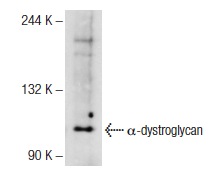
Western blot analysis of α-dystroglycan expression in human brain tissue extract.Application
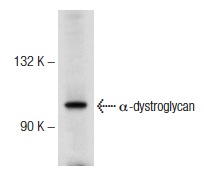
Western blot analysis of α-dystroglycan expression in mouse brain tissue extract.| Product Name | α-dystroglycan Antibody (H-300) |
|---|---|
| Antibody Type | Primary Antibodies |
| Antigen Alias | epitope corresponding to amino acids 30-329 mapping near the N-terminus of dystroglycan precursor of human origin |
| Modification Notes | Dystroglycan (DG) is a cell surface receptor for several extracellular matrix molecules including laminins, Agrin and Perlecan. Dystroglycan function is required for the formation of basement membranes in early development and the organization of Laminin on the cell surface. å-dystroglycan is a membrane- associated, extracellular glycoprotein that is anchored to the cell-membrane by binding to the transmembrane glycoprotein å-dystroglycan to form an å/∫-dystroglycan-complex. Additionally, dystroglycan is part of a multimolecular complex, where it associates with dystrophin, at the sarcolemma, to form the dystrophin-associated protein complex, or with utrophin, at the neuromuscular junction, to form the utrophin-associated protein complex. Dystroglycan is also thought to participate in the clustering of nicotinic acetylcholine receptors at the neuromuscular junction. |
| Clonality | Polyclonal |
|---|---|
| Isotype | IgG |
| Host Species | Rabbit |
| Tested Applications | WBIPIFELISA |
| recommended for detection of α-dystroglycan of mouse, rat and human origin by WB, IP, IF and ELISA also reactive with additional species, including equine, canine, bovine and porcine: |
|
| Species Reactivity | HumanMouseRat |
| Concentration | 1mg/ml |
| Purification | Affinity purified |
| Alternative Names | epitope corresponding to amino acids 30-329 mapping near the N-terminus of dystroglycan precursor of human origin |
|---|---|
| Tissue Specificity | epitope corresponding to amino acids 30-329 mapping near the N-terminus of dystroglycan precursor of human origin |
| Entrez Gene | 1605 |
|---|
Application
Western blot analysis of α-dystroglycan expression in human brain tissue extract.
Application
Western blot analysis of α-dystroglycan expression in mouse brain tissue extract.| Application Notes | recommended for detection of α-dystroglycan of mouse, rat and human origin by WB, IP, IF and ELISA also reactive with additional species, including equine, canine, bovine and porcine: |
|---|
| Form | Liquid |
|---|---|
| Storage Instructions | For short-term storage, store at 4° C. For long-term storage, aliquot and store at -20ºC or below. Avoid multiple freeze-thaw cycles. |
| Storage Buffer | phosphate buffered saline , pH 7.4, 150mM NaCl, 0.02% sodium azide and 50% glycerol. |


