Application
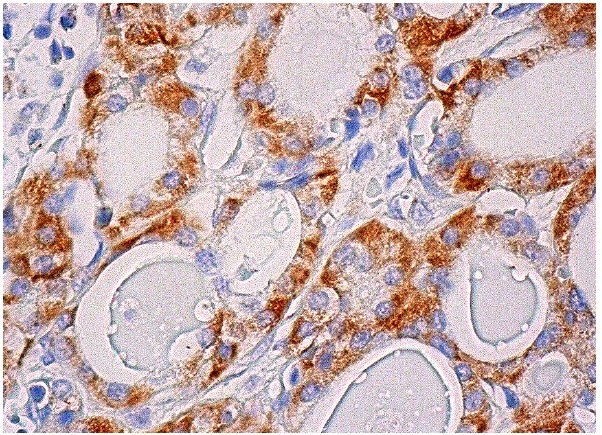
Immunoperoxidase staining of formalin fixed, paraffin-embedded human thyroid gland tissue showing cytoplasmic staining of glandular cells.| Product Name | NCX Antibody (H-300) |
|---|---|
| Antibody Type | Primary Antibodies |
| Antigen Alias | epitope corresponding to amino acids 679-968 mapping at the C-terminus of NCX1 of human origin |
| Modification Notes | Sodium/calcium exchanger proteins are integral membrane proteins primarily seen in cardiac cells. In cardiac myocytes, the concentration of Ca2+ alternates between low levels during relaxation and high levels during contraction. The Na+/Ca2+ exchanger 1 (NCX1) protein mediates Ca2+ extrusion from cardiac cells during relaxation. Four NCX1 isoforms (NCX1.1, NCX1.3, NCX1.7, and NCX1.10) result from alternate splicing. NCX1 mRNA is present at high levels in the heart, with lower levels present in the brain. NCX2 is most abundantly expressed in brain, in contrast the the broader distribution of NCX1, which is also expressed in heart, kidney, lung, smooth and skeletal muscle. The difference in expression for the transporter subtypes is believed to reflect differences in their functional roles. Regulation mechanisms for these exchanger proteins have not been fully characterized. |
| Clonality | Polyclonal |
|---|---|
| Isotype | IgG |
| Host Species | Rabbit |
| Tested Applications | WBIPIFIHCELISA |
| recommended for detection of NCX1, NCX2 and NCX3 precursor and mature forms of mouse, rat and human origin by WB, IP, IF, IHC(P) and ELISA also reactive with additional species, including equine, canine, bovine, porcine and avian: |
|
| Species Reactivity | HumanMouseRat |
| Concentration | 1mg/ml |
| Purification | Affinity purified |
| Alternative Names | epitope corresponding to amino acids 679-968 mapping at the C-terminus of NCX1 of human origin |
|---|---|
| Tissue Specificity | epitope corresponding to amino acids 679-968 mapping at the C-terminus of NCX1 of human origin |
| Entrez Gene | 6546 |
|---|
Application
Immunoperoxidase staining of formalin fixed, paraffin-embedded human thyroid gland tissue showing cytoplasmic staining of glandular cells.| Application Notes | recommended for detection of NCX1, NCX2 and NCX3 precursor and mature forms of mouse, rat and human origin by WB, IP, IF, IHC(P) and ELISA also reactive with additional species, including equine, canine, bovine, porcine and avian: |
|---|
| Form | Liquid |
|---|---|
| Storage Instructions | For short-term storage, store at 4° C. For long-term storage, aliquot and store at -20ºC or below. Avoid multiple freeze-thaw cycles. |
| Storage Buffer | phosphate buffered saline , pH 7.4, 150mM NaCl, 0.02% sodium azide and 50% glycerol. |


