Application
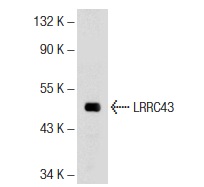
Western blot analysis of LRRC43 expression in NRK whole cell lysate.| Product Name | LRRC43 Antibody (F-14) |
|---|---|
| Antibody Type | Primary Antibodies |
| Antigen Alias | epitope mapping near the C-terminus of LRRC43 of human origin |
| Modification Notes | The leucine-rich (LRR) repeat is a 20-30 amino acid motif that forms a hydrophobic å/∫ horseshoe fold, allowing it to accommodate several leucine residues within a tightly packed core. All LRR repeats contain a variable segment and a highly conserved segment, the latter of which accounts for 11 or 12 residues of the entire LRR motif. The primary function of these motifs is to provide a versatile structural framework to mediate the formation of protein-protein interactions. LRRs are present in a variety of proteins with diverse structure and function, including innate immunity and nervous system development. Several human diseases are associated with mutations in genes encoding LRR-containing proteins. LRRC43 (leucine rich repeat containing 43) is a 656 amino acid protein containing four LRR (leucine-rich) repeats and one LRRCT domain. LRRC43 exists as three alternatively spliced isoforms and is encoded by a gene located on human chromosome 12q24.31. |
| Clonality | Polyclonal |
|---|---|
| Isotype | IgG |
| Host Species | Rabbit |
| Tested Applications | WBIPIFELISA |
| recommended for detection of LRRC43 of mouse and human origin by WB, IP, IF and ELISA non cross-reactive with other LRRC family members also reactive with additional species, including equine: |
|
| Species Reactivity | HumanMouseRat |
| Concentration | 1mg/ml |
| Purification | Affinity purified |
| Alternative Names | epitope mapping near the C-terminus of LRRC43 of human origin |
|---|---|
| Tissue Specificity | epitope mapping near the C-terminus of LRRC43 of human origin |
| Entrez Gene | 254050 |
|---|
Application
Western blot analysis of LRRC43 expression in NRK whole cell lysate.| Application Notes | recommended for detection of LRRC43 of mouse and human origin by WB, IP, IF and ELISA non cross-reactive with other LRRC family members also reactive with additional species, including equine: |
|---|
| Form | Liquid |
|---|---|
| Storage Instructions | For short-term storage, store at 4° C. For long-term storage, aliquot and store at -20ºC or below. Avoid multiple freeze-thaw cycles. |
| Storage Buffer | phosphate buffered saline , pH 7.4, 150mM NaCl, 0.02% sodium azide and 50% glycerol. |


