Application
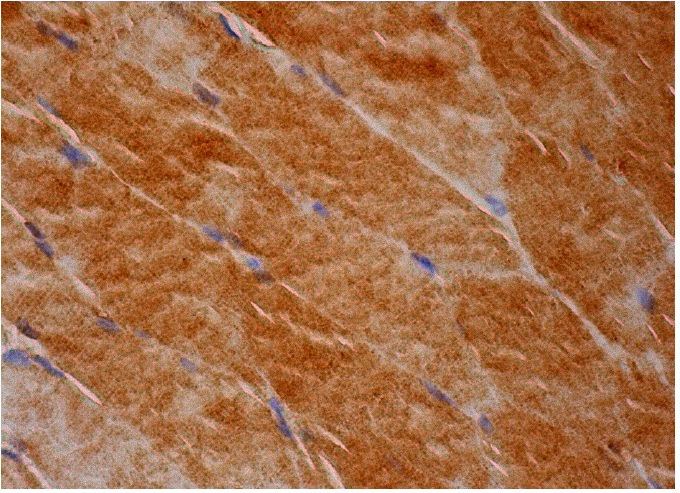
Immunoperoxidase staining of formalin fixed, paraffin-embedded human skeletal muscle tissue showing cytoplasmic staining of myocytes.Application
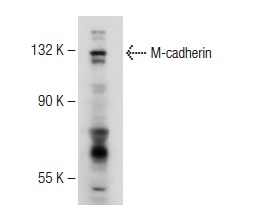
Western blot analysis of M-cadherin expression in SJRH30 whole cell lysate.| Product Name | M-cadherin Antibody (H-71) |
|---|---|
| Antibody Type | Primary Antibodies |
| Antigen Alias | epitope corresponding to amino acids 545-615 mapping near the C-terminus of M-cadherin of human origin |
| Modification Notes | Cadherins are a multigene family of Ca++-dependent cell adhesion molecules. They are transmembrane glycoproteins consisting of an extracellular domain, which mediates Ca++-dependent intercellular adhesion by homophilic interactions, a transmembrane region and a cytoplasmic domain. The extracellular domain is divided into a series of subdomains designated EC1-EC5. Homologies between different members of the cadherin family are most prominent in the cytoplasmic domain and in EC1 and EC2 and much less so in EC5 of the extracellular domain and in the transmembrane region. The binding properties and specificities of the adhesive function are located in the N-terminal part of the molecules. Four members of the cadherin family have been identified and molecularly cloned from mammalian cells. These include the neuronal (N), epithelial (E), placental (P) and muscle (M) cadherins. M-cadherin is not found in fibroblasts but is expressed at low level in myoblasts and is upregulated following induction of myotube formation, suggesting a specific function in skeletal muscle cell differentiation. |
| Clonality | Polyclonal |
|---|---|
| Isotype | IgG |
| Host Species | Rabbit |
| Tested Applications | WBIPIFELISA |
| recommended for detection of M-cadherin of mouse, rat and human origin by WB, IP, IF and ELISA: |
|
| Species Reactivity | HumanMouseRat |
| Concentration | 1mg/ml |
| Purification | Affinity purified |
| Alternative Names | epitope corresponding to amino acids 545-615 mapping near the C-terminus of M-cadherin of human origin |
|---|---|
| Tissue Specificity | epitope corresponding to amino acids 545-615 mapping near the C-terminus of M-cadherin of human origin |
| Entrez Gene | 1013 |
|---|
Application
Immunoperoxidase staining of formalin fixed, paraffin-embedded human skeletal muscle tissue showing cytoplasmic staining of myocytes.
Application
Western blot analysis of M-cadherin expression in SJRH30 whole cell lysate.| Application Notes | recommended for detection of M-cadherin of mouse, rat and human origin by WB, IP, IF and ELISA: |
|---|
| Form | Liquid |
|---|---|
| Storage Instructions | For short-term storage, store at 4° C. For long-term storage, aliquot and store at -20ºC or below. Avoid multiple freeze-thaw cycles. |
| Storage Buffer | phosphate buffered saline , pH 7.4, 150mM NaCl, 0.02% sodium azide and 50% glycerol. |


