Application
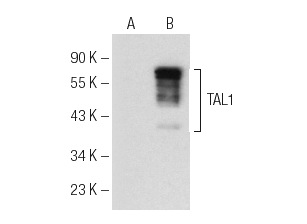
Western blot analysis of TAL1 expression in non-transfected: (A) and human TAL1 transfected: (B) 293T whole cell lysates.| Product Name | TAL1 Antibody (H-60) |
|---|---|
| Antibody Type | Primary Antibodies |
| Antigen Alias | epitope corresponding to amino acids 272-331 mapping at the C-terminus of TAL1 of human origin |
| Modification Notes | Activation of TAL1 characterizes up to 60% of cases of human T cell acute lymphoblastic leukemia, making it the most frequent gain-of-function mutation observed in this disorder. TAL1 (also designated SCL) is a serine phosphoprotein and basic helix-loop-helix transcription factor known to regulate embryonic hematopoiesis. This transcription factor binds as a heterodimer with E2A and HEB/HTF4 to a nucleotide sequence motif termed the E-box. In addition, leukemogenesis is accelerated dramatically by transgenic co-expression of TAL1 and the catalytic subunit of casein kinase IIalpha, a serine/ threonine protein kinase known to modulate the activity of other bHLH transcription factors. |
| Clonality | Polyclonal |
|---|---|
| Isotype | IgG |
| Host Species | Rabbit |
| Tested Applications | WBIPIFELISAGSChIP |
| recommended for detection of TAL1 pp42, pp39 and pp22 isoforms of mouse, rat and human origin by WB, IP, IF and ELISA also reactive with additional species, including equine, canine, bovine and porcine: |
|
| Species Reactivity | HumanMouseRat |
| Concentration | 1mg/ml |
| Purification | Affinity purified |
| Alternative Names | epitope corresponding to amino acids 272-331 mapping at the C-terminus of TAL1 of human origin |
|---|---|
| Tissue Specificity | epitope corresponding to amino acids 272-331 mapping at the C-terminus of TAL1 of human origin |
| Entrez Gene | 6886 |
|---|
Application
Western blot analysis of TAL1 expression in non-transfected: (A) and human TAL1 transfected: (B) 293T whole cell lysates.| Application Notes | recommended for detection of TAL1 pp42, pp39 and pp22 isoforms of mouse, rat and human origin by WB, IP, IF and ELISA also reactive with additional species, including equine, canine, bovine and porcine: |
|---|
| Form | Liquid |
|---|---|
| Storage Instructions | For short-term storage, store at 4° C. For long-term storage, aliquot and store at -20ºC or below. Avoid multiple freeze-thaw cycles. |
| Storage Buffer | phosphate buffered saline , pH 7.4, 150mM NaCl, 0.02% sodium azide and 50% glycerol. |


