Application
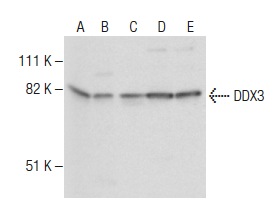
Western blot analysis of DDX3 expression in HeLa (A), NIH/3T3 (B), A-431 (C) and Jurkat (D) nuclear extracts and PC-12 whole cell lysate (E).| Product Name | DDX3 Antibody (H-114) |
|---|---|
| Antibody Type | Primary Antibodies |
| Antigen Alias | epitope corresponding to amino acids 1-114 mapping at the N-terminus of DDX3x of human origin |
| Modification Notes | DEAD box proteins, characterized by the conserved motif Asp-Glu-Ala-Asp, are putative RNA helicases implicated in several cellular processes involving modifications of RNA secondary structure and ribosome and spliceosome assembly. Based on their distribution patterns, some members of this family may be involved in embryogenesis, spermatogenesis, and cellular growth and division. DDX3 (DEAD box polypeptide 3) is involved in RNA metabolism. Two DDX3 paralogs are found in humans; DDX3X is encoded by a gene found on the X chromosome while DDX3Y is encoded by a gene on the Y chromosome. DDX3Y is exclusively expressed in testis and is required for normal spermatogenesis. DDX3X is ubiquitously expressed and predominantly localizes to the nuclear speckles, participating in RNA splicing, transcription, translation initiation, mRNA transport and cell cycle regulation. DDX3X also partakes in HIV-1 replication and hepatitis C viral infections. |
| Clonality | Polyclonal |
|---|---|
| Isotype | IgG |
| Host Species | Rabbit |
| Tested Applications | WBIPIFELISA |
| recommended for detection of DDX3x and DDX3y of mouse, rat and human origin by WB, IP, IF and ELISA also reactive with additional species, including canine and porcine: |
|
| Species Reactivity | HumanMouseRat |
| Concentration | 1mg/ml |
| Purification | Affinity purified |
| Alternative Names | epitope corresponding to amino acids 1-114 mapping at the N-terminus of DDX3x of human origin |
|---|---|
| Tissue Specificity | epitope corresponding to amino acids 1-114 mapping at the N-terminus of DDX3x of human origin |
| Entrez Gene | 1654 |
|---|
Application
Western blot analysis of DDX3 expression in HeLa (A), NIH/3T3 (B), A-431 (C) and Jurkat (D) nuclear extracts and PC-12 whole cell lysate (E).| Application Notes | recommended for detection of DDX3x and DDX3y of mouse, rat and human origin by WB, IP, IF and ELISA also reactive with additional species, including canine and porcine: |
|---|
| Form | Liquid |
|---|---|
| Storage Instructions | For short-term storage, store at 4° C. For long-term storage, aliquot and store at -20ºC or below. Avoid multiple freeze-thaw cycles. |
| Storage Buffer | phosphate buffered saline , pH 7.4, 150mM NaCl, 0.02% sodium azide and 50% glycerol. |


