Application
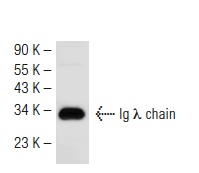
Western blot analysis of Ig λ chain expression in Ramos whole cell lysate.| Product Name | Ig λ chain Antibody (H-110) |
|---|---|
| Antibody Type | Primary Antibodies |
| Antigen Alias | epitope corresponding to amino acids 126-235 mapping at the C-terminus of Ig λ chain of human origin |
| Modification Notes | Antibody producing cells of the immune system require multiple rearrangements of immunoglobulin (antibody, Ig) genes. Immunoglobulins are four-chain, Y-shaped, monomeric structures of two identical heavy chains and two identical light chains held together through interchain disulfide bonds. Immunoglobulins in vertebrates help to remove non-self molecules or cells (antigens) by recognizing and binding to the antigen and carrying out effector functions that activate the immune system. Variable genetic combinations of the five heavy chain classes (M, D, G, E and A) and the two light chain isotypes, ˚ and ¬, confer the role of an antibody. The variable region genes encoding immunoglobulin ˚ and ¬ chains are assembled from three DNA segments, the V, C and J genes. Human ˚ light chain genes map to chromosome 2 and the human ¬ light chain genes map to chromosome 22. ˚ gene recombination can precede ¬ gene recombination during B cell ontogeny and only a single light chain type is expressed in individual B cells. Antibodies in camels and sharks can lack light chain, suggesting that light chain may not be essential for antigen binding in some vertebrates. |
| Clonality | Polyclonal |
|---|---|
| Isotype | IgG |
| Host Species | Rabbit |
| Tested Applications | WBIPIFELISA |
| recommended for detection of Ig λ Chain of human origin by WB, IP, IF and ELISA also reactive with additional species, including canine: |
|
| Species Reactivity | HumanMouseRat |
| Concentration | 1mg/ml |
| Purification | Affinity purified |
| Alternative Names | epitope corresponding to amino acids 126-235 mapping at the C-terminus of Ig &lambda chain of human origin |
|---|---|
| Tissue Specificity | epitope corresponding to amino acids 126-235 mapping at the C-terminus of Ig λ chain of human origin |
| Entrez Gene | 3538 |
|---|
Application
Western blot analysis of Ig λ chain expression in Ramos whole cell lysate.| Application Notes | recommended for detection of Ig λ Chain of human origin by WB, IP, IF and ELISA also reactive with additional species, including canine: |
|---|
| Form | Liquid |
|---|---|
| Storage Instructions | For short-term storage, store at 4° C. For long-term storage, aliquot and store at -20ºC or below. Avoid multiple freeze-thaw cycles. |
| Storage Buffer | phosphate buffered saline , pH 7.4, 150mM NaCl, 0.02% sodium azide and 50% glycerol. |


