Application
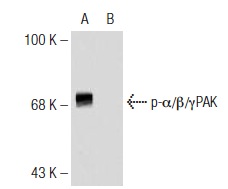
Western blot analysis of α/β/γPAK phosphorylation in untreated (A) and lambda protein phosphatase-treated (B) rat hippocampal tissue extracts.| Product Name | p-α/β/γPAK Antibody (Thr 402) |
|---|---|
| Antibody Type | Primary Antibodies |
| Antigen Alias | recommended for detection of Thr 402 phosphorylated γPAK and correspondingly phosphorylated αPAK and βPAK of mouse, rat and human origin by WB and IP; also reactive with additional species, including bovine and canine |
| Modification | Phosphoralated |
| Modification Notes | Three isoforms of serine/threonine kinases, designated aPAK p68, bPAK p65 and gPAK p62, have been shown to exhibit a high degree of sequence homol-ogy with the S. cerevisiae kinase Ste 20, involved in pheromone signaling. The a, b and gPAK isoforms complex specifically with Rac1 and Cdc42 in their active GTP-bound state, inhibiting their intrinsic GTPase activity leading to their autophosphorylation. There are eight sites of autophosphorylation on gPAK, including Ser 19, Ser 141 and Thr 402, and phosphorylation of Ser 141 and Thr 402 is correlated with gPAK activation. Once phosphorylated and their affinity for Rac/Cdc42 reduced, the PAK isoforms disassociate from the complex to seek downstream substrates. One such putative substrate is Mek kinase, an upstream effector of Mek4 which is involved in the JNK signaling pathway. While the PAK isoforms interact in a GTP-dependent manner with Rac1 and Cdc42, they do not interact with Rho. |
| Clonality | Polyclonal |
|---|---|
| Isotype | IgG |
| Host Species | Rabbit |
| Tested Applications | WBIP |
| WB:1:500~1:2000 IP:1:100~1:500 Notes:Optimal dilutions/concentrations should be determined by the researcher. |
|
| Species Reactivity | HumanMouseRat |
| Concentration | 1mg/ml |
| Purification | Affinity purified |
| Alternative Names | recommended for detection of Thr 402 phosphorylated &gamma PAK and correspondingly phosphorylated &alpha PAK and &beta PAK of mouse rat and human origin by WB and IP also reactive with additional species including bovine and canine |
|---|---|
| Tissue Specificity | recommended for detection of Thr 402 phosphorylated γPAK and correspondingly phosphorylated αPAK and βPAK of mouse, rat and human origin by WB and IP; also reactive with additional species, including bovine and canine |
| Entrez Gene | 5058 |
|---|
Application
Western blot analysis of α/β/γPAK phosphorylation in untreated (A) and lambda protein phosphatase-treated (B) rat hippocampal tissue extracts.| Application Notes | WB:1:500~1:2000 IP:1:100~1:500 Notes:Optimal dilutions/concentrations should be determined by the researcher. |
|---|
| Form | Liquid |
|---|---|
| Storage Instructions | For short-term storage, store at 4° C. For long-term storage, aliquot and store at -20ºC or below. Avoid multiple freeze-thaw cycles. |
| Storage Buffer | phosphate buffered saline , pH 7.4, 150mM NaCl, 0.02% sodium azide and 50% glycerol. |


