Application
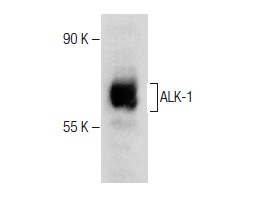
Western blot analysis of ALK-1 expression in human platelet whole cell lysate.| Product Name | ALK-1 Antibody (H-150) |
|---|---|
| Antibody Type | Primary Antibodies |
| Antigen Alias | epitope corresponding to amino acids 31-180 mapping within an N-terminal extracellular domain of ALK-1 of human origin |
| Modification Notes | Hereditary hemorrhagic telangiectasia (HHT) is an autosomal dominant disorder characterized by vascular abnormalities such as dilated vessels, hemorrhages, liver and lung congestion, and brain or heart ischemia. Mutations in two genes, Endoglin (also designated CD105) and ALK-1 (activin receptor-like kinase 1, also designated TGF∫ Superfamily RI), are responsible for HHT. Endoglin is mutated in HHT1, and ALK-1 is mutated in HHT2, both of which are thought to be caused by haploinsufficiency. Endoglin and ALK-1 are type III and type I members of the TGF∫ receptor superfamily, respectively, that are expressed on vascular endothelial cells. Endoglin can only bind ligands of the TGF∫ superfamily via association with the respective ligand binding receptors for TGF∫1, TGF∫3, Activin-A, BMP-2 and BMP-7. The human ALK-1 gene encodes two protein species which exist as a result of either glycosylation or alternative splicing events. ALK-1 preferentially binds TGF∫1 and is expressed in bone marrow stromal cells, lung, brain, kidney and spleen. |
| Clonality | Polyclonal |
|---|---|
| Isotype | IgG |
| Host Species | Rabbit |
| Tested Applications | WBIPIFELISA |
| recommended for detection of ALK-1 of mouse, rat and human origin by WB, IP, IF and ELISA also reactive with additional species, including equine, canine and porcine: |
|
| Species Reactivity | HumanMouseRat |
| Concentration | 1mg/ml |
| Purification | Affinity purified |
| Alternative Names | epitope corresponding to amino acids 31-180 mapping within an N-terminal extracellular domain of ALK-1 of human origin |
|---|---|
| Tissue Specificity | epitope corresponding to amino acids 31-180 mapping within an N-terminal extracellular domain of ALK-1 of human origin |
| Entrez Gene | 94 |
|---|
Application
Western blot analysis of ALK-1 expression in human platelet whole cell lysate.| Application Notes | recommended for detection of ALK-1 of mouse, rat and human origin by WB, IP, IF and ELISA also reactive with additional species, including equine, canine and porcine: |
|---|
| Form | Liquid |
|---|---|
| Storage Instructions | For short-term storage, store at 4° C. For long-term storage, aliquot and store at -20ºC or below. Avoid multiple freeze-thaw cycles. |
| Storage Buffer | phosphate buffered saline , pH 7.4, 150mM NaCl, 0.02% sodium azide and 50% glycerol. |


