Application
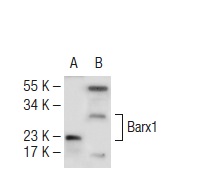
Western blot analysis of Barx1 expression in mouse pancreas tissue extract (A) and MIA PaCa-2 whole cell lysate (B).| Product Name | Barx1 Antibody (H-55) |
|---|---|
| Antibody Type | Primary Antibodies |
| Antigen Alias | epitope corresponding to amino acids 52-106 mapping within an internal region of Barx1 of human origin |
| Modification Notes | The BAR homeobox (Barx) family of proteins comprise Barx1 and Barx2. These proteins are regulators of place-dependent morphogenesis and play important roles in controlling the expression patterns of cell adhesion molecules. Barx1, a 226-amino acid nuclear protein, is expressed primarily in testis, heart, and craniofacial tissue. Barx1 is a homeodomain transcription factor important in odontogenesis, craniofacial development, and stomach organogenesis. Barx1 controls mesenchymal cell expression of two secreted Wnt antagonists, sFRP1 and sFRP2, proteins that are important in the development of the gastric endoderm which occurs before the epithelial differentiation. During early stages of molar development, Barx1 directs the undetermined ectomesenchymal cells in the proximal region of the jaws to follow the pathway of multicuspid tooth development. Fibroblast growth factor-8 (FGF8) stimulates Barx1 expression, while bone morphogenetic protein-4 (BMP4) inhibits Barx1 expression. |
| Clonality | Polyclonal |
|---|---|
| Isotype | IgG |
| Host Species | Rabbit |
| Tested Applications | WBIPIFELISA |
| recommended for detection of Barx1 isoform 1 of mouse, rat and human origin by WB, IP, IF and ELISA non cross-reactive with Barx1 isoform 2 also reactive with additional species, including canine, porcine and avian: |
|
| Species Reactivity | HumanMouseRat |
| Concentration | 1mg/ml |
| Purification | Affinity purified |
| Alternative Names | epitope corresponding to amino acids 52-106 mapping within an internal region of Barx1 of human origin |
|---|---|
| Tissue Specificity | epitope corresponding to amino acids 52-106 mapping within an internal region of Barx1 of human origin |
| Entrez Gene | 56033 |
|---|
Application
Western blot analysis of Barx1 expression in mouse pancreas tissue extract (A) and MIA PaCa-2 whole cell lysate (B).| Application Notes | recommended for detection of Barx1 isoform 1 of mouse, rat and human origin by WB, IP, IF and ELISA non cross-reactive with Barx1 isoform 2 also reactive with additional species, including canine, porcine and avian: |
|---|
| Form | Liquid |
|---|---|
| Storage Instructions | For short-term storage, store at 4° C. For long-term storage, aliquot and store at -20ºC or below. Avoid multiple freeze-thaw cycles. |
| Storage Buffer | phosphate buffered saline , pH 7.4, 150mM NaCl, 0.02% sodium azide and 50% glycerol. |


