Application
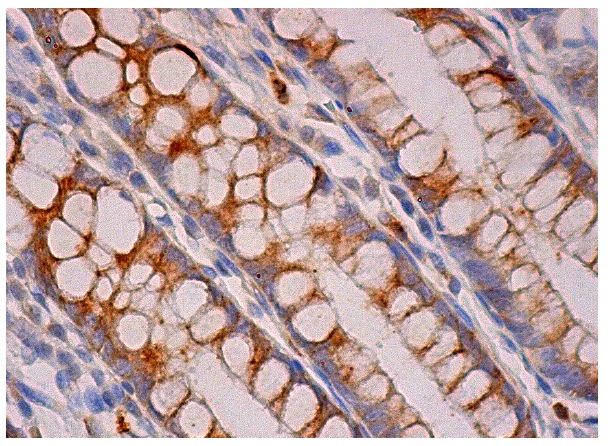
Immunoperoxidase staining of formalin fixed, paraffin-embedded human rectum tissue showing cytoplasmic staining of glandular cells.Application
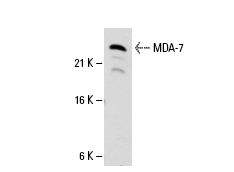
Western blot analysis of MDA-7 expression in HeLa whole cell lysate.| Product Name | MDA-7 Antibody (H-190) |
|---|---|
| Antibody Type | Primary Antibodies |
| Antigen Alias | epitope corresponding to amino acids 1-190 mapping at the N-terminus of MDA-7 of human origin |
| Modification Notes | MDA-7 (melanoma differentiation associated protein-7) was initially identified in cultured human melanoma cells following treatment with interferon-b and mezerin, a treatment that causes the cells to lose proliferative capacity and terminally differentiate. MDA-7 was shown to have antiproliferative properties in human melanoma cells and to reduce cell growth in tumors of diverse origin. The level of MDA-7 expression is inversely correlated with human melanoma progression, with the highest levels found in normal, proliferating melanocytes and the lowest levels found in metastatic melanoma. Overexpression of MDA-7 in human breast cancer cells has been shown to induce apoptosis and upregulate Bax expression in a p53-independent manner. However, MDA-7 does not elicit growth inhibition and apoptosis in normal, non-tumor cells. |
| Clonality | Polyclonal |
|---|---|
| Isotype | IgG |
| Host Species | Rabbit |
| Tested Applications | WBIPIFIHCELISA |
| recommended for detection of MDA-7 (also designated IL-24) of human and, to a lesser extent, mouse and rat origin by WB, IP, IF, IHC(P) and ELISA: |
|
| Species Reactivity | HumanMouseRat |
| Concentration | 1mg/ml |
| Purification | Affinity purified |
| Alternative Names | epitope corresponding to amino acids 1-190 mapping at the N-terminus of MDA-7 of human origin |
|---|---|
| Tissue Specificity | epitope corresponding to amino acids 1-190 mapping at the N-terminus of MDA-7 of human origin |
| Entrez Gene | 11009 |
|---|
Application
Immunoperoxidase staining of formalin fixed, paraffin-embedded human rectum tissue showing cytoplasmic staining of glandular cells.
Application
Western blot analysis of MDA-7 expression in HeLa whole cell lysate.| Application Notes | recommended for detection of MDA-7 (also designated IL-24) of human and, to a lesser extent, mouse and rat origin by WB, IP, IF, IHC(P) and ELISA: |
|---|
| Form | Liquid |
|---|---|
| Storage Instructions | For short-term storage, store at 4° C. For long-term storage, aliquot and store at -20ºC or below. Avoid multiple freeze-thaw cycles. |
| Storage Buffer | phosphate buffered saline , pH 7.4, 150mM NaCl, 0.02% sodium azide and 50% glycerol. |


