Application
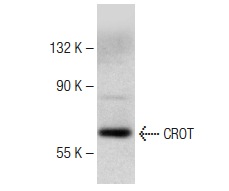
Western blot analysis of CROT expression in A-431 whole cell lysate.Application
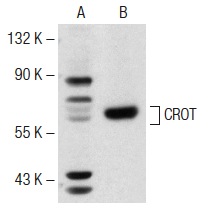
Western blot analysis of CROT expression in non-transfected: (A) and human CROT transfected: (B) 293T whole cell lysates.| Product Name | CROT Antibody (H-300) |
|---|---|
| Antibody Type | Primary Antibodies |
| Antigen Alias | epitope corresponding to amino acids 1-300 mapping at the N-terminus of CROT of human origin |
| Modification Notes | CROT (carnitine O-octanoyltransferase), also called COT (carnitine octanoyl-transferase), is a member of the carnitine/choline acetyltransferase protein family, which also includes CAT, CPTI, CPTI-M and CPTII. Carnitine/choline acetyltransferase family members are essential for the ∫-oxidation of fatty acids. CROT localizes to peroxisomes and is highly expressed in liver, kidney and proximal intestinal epithelium. CROT plays a role in lipid metabolism, catalyzing the reversible conversion of acyl-CoAs to their corresponding carnitine esters—a crucial step in facilitating the transport of fatty acids out of peroxisomes to mitochondria, where they can be further degraded. With a preference for straight and branched medium-chain acyl-CoAs (C6-C10 chain length), CROT plays an important role in energy metabolism in eukaryotes. In addition, CROT activity can be inhibited by malonyl-CoA. |
| Clonality | Polyclonal |
|---|---|
| Isotype | IgG |
| Host Species | Rabbit |
| Tested Applications | WBIPIFELISA |
| recommended for detection of CROT of mouse, rat and human origin by WB, IP, IF and ELISA also reactive with additional species, including equine, bovine and porcine: |
|
| Species Reactivity | HumanMouseRat |
| Concentration | 1mg/ml |
| Purification | Affinity purified |
| Alternative Names | epitope corresponding to amino acids 1-300 mapping at the N-terminus of CROT of human origin |
|---|---|
| Tissue Specificity | epitope corresponding to amino acids 1-300 mapping at the N-terminus of CROT of human origin |
Application
Western blot analysis of CROT expression in A-431 whole cell lysate.
Application
Western blot analysis of CROT expression in non-transfected: (A) and human CROT transfected: (B) 293T whole cell lysates.| Application Notes | recommended for detection of CROT of mouse, rat and human origin by WB, IP, IF and ELISA also reactive with additional species, including equine, bovine and porcine: |
|---|
| Form | Liquid |
|---|---|
| Storage Instructions | For short-term storage, store at 4° C. For long-term storage, aliquot and store at -20ºC or below. Avoid multiple freeze-thaw cycles. |
| Storage Buffer | phosphate buffered saline , pH 7.4, 150mM NaCl, 0.02% sodium azide and 50% glycerol. |


