Application
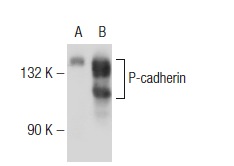
Western blot analysis of P-cadherin expression in non-transfected: (A) and human P-cadherin transfected: (B) 293T whole cell lysates.Application
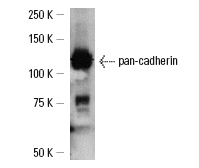
Western blot analysis of cadherin expression in F9 whole cell lysate.| Product Name | pan-cadherin Antibody (H-300) |
|---|---|
| Antibody Type | Primary Antibodies |
| Antigen Alias | epitope corresponding to amino acids 530-829 mapping at the C-terminus of P-cadherin of human origin |
| Modification Notes | Cadherins comprise a family of Ca++-dependent adhesion molecules that function to mediate cell-cell binding critical to the maintenance of tissue structure and morphogenesis (1-4). The classical cadherins, E-, N- and P-cadherin, consist of large extracellular domains characterized by a series of five homologous NH2 terminal repeats. The most distal of these cadherins is thought to be responsible for binding specificity, transmembrane domains and carboxy terminal intracellular domains (5,6). The relatively short intracellular domains interact with a variety of cytoplasmic proteins, such as b-catenin, to regulate cadherin function (7). Members of this family of adhesion proteins include rat cadherin K (and its human homolog, cadherin 6), R-cadherin, B-cadherin, E/P cadherin and cadherin-5 (8). |
| Clonality | Polyclonal |
|---|---|
| Isotype | IgG |
| Host Species | Rabbit |
| Tested Applications | WBIPIFELISA |
| broadly recommended for detection of cadherin family members, including P-cadherin, N-cadherin, E-cadherin, K-cadherin, M-cadherin and R-cadherin of mouse, rat, human and Xenopus origin by WB, IP, IF and ELISA: |
|
| Species Reactivity | HumanMouseRat |
| Concentration | 1mg/ml |
| Purification | Affinity purified |
| Alternative Names | epitope corresponding to amino acids 530-829 mapping at the C-terminus of P-cadherin of human origin |
|---|---|
| Tissue Specificity | epitope corresponding to amino acids 530-829 mapping at the C-terminus of P-cadherin of human origin |
| Entrez Gene | 1001 |
|---|
Application
Western blot analysis of P-cadherin expression in non-transfected: (A) and human P-cadherin transfected: (B) 293T whole cell lysates.
Application
Western blot analysis of cadherin expression in F9 whole cell lysate.| Application Notes | broadly recommended for detection of cadherin family members, including P-cadherin, N-cadherin, E-cadherin, K-cadherin, M-cadherin and R-cadherin of mouse, rat, human and Xenopus origin by WB, IP, IF and ELISA: |
|---|
| Form | Liquid |
|---|---|
| Storage Instructions | For short-term storage, store at 4° C. For long-term storage, aliquot and store at -20ºC or below. Avoid multiple freeze-thaw cycles. |
| Storage Buffer | phosphate buffered saline , pH 7.4, 150mM NaCl, 0.02% sodium azide and 50% glycerol. |


