Application
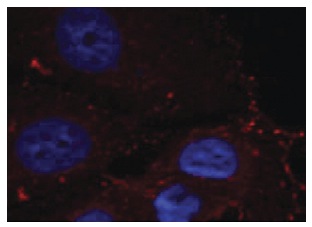
Immunofluorescence staining of methanol-fixed HeLa cells showing cytoplasmic localization.Application
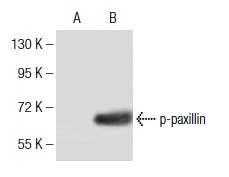
Western blot analysis of paxillin phosphorylation expression in untreated (A) and EGF treated (B) HT29 whole cell lysates.| Product Name | p-paxillin Antibody (Tyr 88) |
|---|---|
| Antibody Type | Primary Antibodies |
| Antigen Alias | recommended for detection of Tyr 88 phosphorylated paxillin of human origin by WB, IP and IF |
| Modification | Phosphoralated |
| Modification Notes | The effects of some oncogenes, growth factors and neuropeptides are mediated by tyrosine phosphorylation of focal adhesion kinase (FAK) and paxillin cytoskeletal proteins. A rapid increase in tyrosine phosphorylation of paxillin, FAK and Crk-associated substrate (CAS) are prominent early events triggered by many G-protein-coupled receptors. In addition to G protein-coupled receptors, angiotensin IV (Ang IV), protein kinase C and other proteins can also mediate the tyrosine phosphorylation of paxillin. Paxillin must bind FAK for maximal phosphorylation in response to cell adhesion. FAK may function to direct tyrosine phosphorylation of paxillin in the process of transformation by the src oncogene. Tyrosine phosphorylated FAK and paxillin function to regulate the signaling mechanism of the rapid nongenomic action of dexamethasone on the Actin cytoskeleton. In glomerular epithelial cells, TNFa induces substantial reorganization of Actin cytoskeleton and focal adhesions. TNFa also simultaneoulsy mediates tyrosine phosphorylation of paxillin and FAK, which regulate Actin polymerization and the formation of focal adhesions, and may be directly involved in the redistribution of Actin. |
| Clonality | Polyclonal |
|---|---|
| Isotype | IgG |
| Host Species | Rabbit |
| Tested Applications | WBIPIF |
| WB:1:500~1:2000 IP:1:100~1:500 IF:1:200~1:500 Notes:Optimal dilutions/concentrations should be determined by the researcher. |
|
| Species Reactivity | HumanMouseRat |
| Concentration | 1mg/ml |
| Purification | Affinity purified |
| Alternative Names | recommended for detection of Tyr 88 phosphorylated paxillin of human origin by WB IP and IF |
|---|---|
| Tissue Specificity | recommended for detection of Tyr 88 phosphorylated paxillin of human origin by WB, IP and IF |
| Entrez Gene | 5829 |
|---|
Application
Immunofluorescence staining of methanol-fixed HeLa cells showing cytoplasmic localization.
Application
Western blot analysis of paxillin phosphorylation expression in untreated (A) and EGF treated (B) HT29 whole cell lysates.| Application Notes | WB:1:500~1:2000 IP:1:100~1:500 IF:1:200~1:500 Notes:Optimal dilutions/concentrations should be determined by the researcher. |
|---|
| Form | Liquid |
|---|---|
| Storage Instructions | For short-term storage, store at 4° C. For long-term storage, aliquot and store at -20ºC or below. Avoid multiple freeze-thaw cycles. |
| Storage Buffer | phosphate buffered saline , pH 7.4, 150mM NaCl, 0.02% sodium azide and 50% glycerol. |


