Application
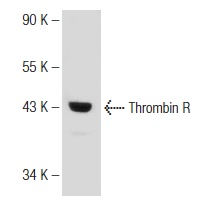
Western blot analysis of Thrombin R expression in KNRK whole cell lysate.| Product Name | Thrombin R Antibody (H-111) |
|---|---|
| Antibody Type | Primary Antibodies |
| Antigen Alias | epitope corresponding to amino acids 1-111 mapping at the N-terminus of Thrombin receptor of human origin |
| Modification Notes | Thrombin is a serine protease that is involved in platelet aggregation and blood coagulation. It is cleaved from its precursor, prothrombin, and converts fibrinogen to Fibrin in the final step of the clotting cascade. Thrombin mediates its regulatory effects by activating cell surface receptors. These receptors, including Thrombin R (also designated PAR-1, for protease-activated receptor-1), PAR-2 and PAR-3, are members of the G protein-coupled receptor family, and share a similar gene structure. Thrombin cleaves its receptor, releasing a 41 amino acid peptide that acts as a platelet agonist. Upon this activation by thrombin, the Thrombin Rs trigger an increase in cytosolic Ca(2+) concentration. Unactivated Thrombin R cycles between the cell surface and an intracellular pool, while activated Thrombin R internalizes rapidly and is degraded in the lysosomes. The human Thrombin R is also known to be regulated by Sp1 and Sp3 transcription factors. |
| Clonality | Polyclonal |
|---|---|
| Isotype | IgG |
| Host Species | Rabbit |
| Tested Applications | WBIPIFELISA |
| recommended for detection of Thrombin receptor of mouse, rat and human origin by WB, IP, IF and ELISA: |
|
| Species Reactivity | HumanMouseRat |
| Concentration | 1mg/ml |
| Purification | Affinity purified |
| Alternative Names | epitope corresponding to amino acids 1-111 mapping at the N-terminus of Thrombin receptor of human origin |
|---|---|
| Tissue Specificity | epitope corresponding to amino acids 1-111 mapping at the N-terminus of Thrombin receptor of human origin |
| Entrez Gene | 2149 |
|---|
Application
Western blot analysis of Thrombin R expression in KNRK whole cell lysate.| Application Notes | recommended for detection of Thrombin receptor of mouse, rat and human origin by WB, IP, IF and ELISA: |
|---|
| Form | Liquid |
|---|---|
| Storage Instructions | For short-term storage, store at 4° C. For long-term storage, aliquot and store at -20ºC or below. Avoid multiple freeze-thaw cycles. |
| Storage Buffer | phosphate buffered saline , pH 7.4, 150mM NaCl, 0.02% sodium azide and 50% glycerol. |


