Application
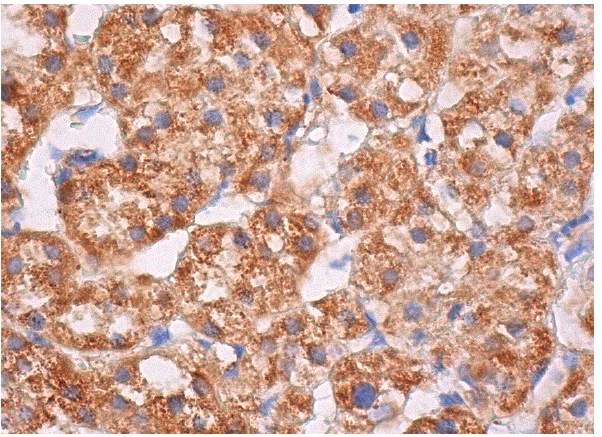
Immunoperoxidase staining of formalin fixed, paraffin-embedded human adrenal gland tissue showing cytoplasmic staining of glandular cells.Application
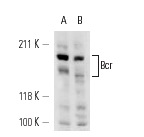
Western blot analysis of Bcr expression in K-562 (A) and HeLa (B) whole cell lysates.| Product Name | Bcr Antibody (C-20) |
|---|---|
| Antibody Type | Primary Antibodies |
| Antigen Alias | epitope mapping at the C-terminus of Bcr of human origin |
| Modification Notes | The Bcr gene, mapping on chromosome 22, was initially identified on the basis of its fusion with the c-Abl proto-oncogene on chromosome 9 resulting in the generation of the Philadelphia chromosome in 90-95% of patients with chronic myelogenous leukemia (CML). The Bcr gene encodes for the Breakpoint cluster region protein (Bcr). A consequence of this translocation is the generation of a Bcr/c-Abl mRNA encoding an activated c-Abl protein kinase. The Bcr gene has been shown to encode a GTPase-activating protein (GAP) specific for the Ras-related GTP-binding protein, Rac 1 p21. While it has been speculated that the Bcr protein may also stimulate Rac 2 p21 GTPase activity, it has no effect on Ras p21 or Rho p21 GTPases. It is of interest that the GAP domain of Bcr maps outside of the region that remains on chromosome 22 (Philadelphia chromosome) in CML. |
| Clonality | Polyclonal |
|---|---|
| Isotype | IgG |
| Host Species | Rabbit |
| Tested Applications | WBIPIFIHCELISA |
| recommended for detection of Bcr of mouse, rat and human origin by WB, IP, IF, IHC(P) and ELISA non cross-reactive with Bcr/Abl fusion proteins also reactive with additional species, including canine, bovine, porcine and avian: |
|
| Species Reactivity | HumanMouseRat |
| Concentration | 1mg/ml |
| Purification | Affinity purified |
| Alternative Names | epitope mapping at the C-terminus of Bcr of human origin |
|---|---|
| Tissue Specificity | epitope mapping at the C-terminus of Bcr of human origin |
| Entrez Gene | 613 |
|---|
Application
Immunoperoxidase staining of formalin fixed, paraffin-embedded human adrenal gland tissue showing cytoplasmic staining of glandular cells.
Application
Western blot analysis of Bcr expression in K-562 (A) and HeLa (B) whole cell lysates.| Application Notes | recommended for detection of Bcr of mouse, rat and human origin by WB, IP, IF, IHC(P) and ELISA non cross-reactive with Bcr/Abl fusion proteins also reactive with additional species, including canine, bovine, porcine and avian: |
|---|
| Form | Liquid |
|---|---|
| Storage Instructions | For short-term storage, store at 4° C. For long-term storage, aliquot and store at -20ºC or below. Avoid multiple freeze-thaw cycles. |
| Storage Buffer | phosphate buffered saline , pH 7.4, 150mM NaCl, 0.02% sodium azide and 50% glycerol. |


