Application
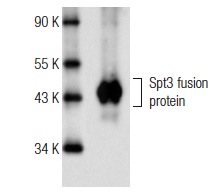
Western blot analysis of yeast recombinant Spt3 fusion protein.| Product Name | Spt3 Antibody (Y-150) |
|---|---|
| Antibody Type | Primary Antibodies |
| Antigen Alias | epitope corresponding to amino acids 1-150 mapping at the N-terminus of Spt3 of Saccharomyces cerevisiae origin |
| Modification Notes | The transcription of many RNA polymerase II-dependent genes requires Spt3, a member of the S. cerevisiae SAGA complex (1). Transcription from delta sequences, the long terminal repeats that flank yeast Ty elements, requires the yeast SPT3 gene (2). Spt3 and Spt20 work together to recruit TATA-box binding protein (TBP) to the core promoter allowing TBP to bind to SAGA-dependent promoters (1,3). Null mutations in the Spt3 gene cause defects in sporulation, diploid filamentous growth, and haploid invasive growth, indicating that Spt3 has an important role in both mating and development pathways in yeast (2,4). At the promoters of some genes including yeast HO, HIS3 and TRP3 genes, Spt3 inhibits binding of TBP, resulting in reduced transcription (5,6). This repressive effect of Spt3 can be overcome by another member of the SAGA complex, GCN5, which promotes the formation of a TBP/TFIIA complex by histone acetylation (6). |
| Clonality | Polyclonal |
|---|---|
| Isotype | IgG |
| Host Species | Rabbit |
| Tested Applications | WBIPIFELISA |
| recommended for detection of Spt3 of Saccaromyces cerevisiae origin by WB, IP, IF and ELISA: |
|
| Species Reactivity | HumanMouseRat |
| Concentration | 1mg/ml |
| Purification | Affinity purified |
| Alternative Names | epitope corresponding to amino acids 1-150 mapping at the N-terminus of Spt3 of Saccharomyces cerevisiae origin |
|---|---|
| Tissue Specificity | epitope corresponding to amino acids 1-150 mapping at the N-terminus of Spt3 of Saccharomyces cerevisiae origin |
Application
Western blot analysis of yeast recombinant Spt3 fusion protein.| Application Notes | recommended for detection of Spt3 of Saccaromyces cerevisiae origin by WB, IP, IF and ELISA: |
|---|
| Form | Liquid |
|---|---|
| Storage Instructions | For short-term storage, store at 4° C. For long-term storage, aliquot and store at -20ºC or below. Avoid multiple freeze-thaw cycles. |
| Storage Buffer | phosphate buffered saline , pH 7.4, 150mM NaCl, 0.02% sodium azide and 50% glycerol. |


