Application
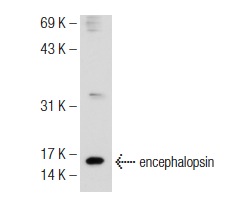
Western blot analysis of encephalopsin expression in SK-N-MC whole cell lysate.| Product Name | encephalopsin Antibody (H-76) |
|---|---|
| Antibody Type | Primary Antibodies |
| Antigen Alias | epitope corresponding to amino acids 327-402 mapping at the C-terminus of encephalopsin of human origin |
| Modification Notes | Encephalopsin is the first putative extraocular opsin identified in mammals and may play a role in encephalic photoreception. Also designated Panopsin, encephalopsin may play a role in non-visual photic processes such as the entrainment of circadian rhythm or the regulation of pineal melatonin production. Encephalopsin shows strong and specific expression in the brain. In the cortex and cerebellum, encephalopsin expression is considerably higher and more highly patterned in the adult than in the neonate. In addition to encephalopsin, other classical visual opsins Rgr-opsin, peropsin and melanopsin are all expressed in fetal development by E11.5, unlike the murine rod and cone opsins that exhibit post-natal expression, such as P1 for ultraviolet cone opsin and P5 for rod opsin. |
| Clonality | Polyclonal |
|---|---|
| Isotype | IgG |
| Host Species | Rabbit |
| Tested Applications | WBIPIFELISA |
| recommended for detection of encephalopsin of mouse, rat and human origin by WB, IP, IF and ELISA also reactive with additional species, including equine and canine: |
|
| Species Reactivity | HumanMouseRat |
| Concentration | 1mg/ml |
| Purification | Affinity purified |
| Alternative Names | epitope corresponding to amino acids 327-402 mapping at the C-terminus of encephalopsin of human origin |
|---|---|
| Tissue Specificity | epitope corresponding to amino acids 327-402 mapping at the C-terminus of encephalopsin of human origin |
| Entrez Gene | 23596 |
|---|
Application
Western blot analysis of encephalopsin expression in SK-N-MC whole cell lysate.| Application Notes | recommended for detection of encephalopsin of mouse, rat and human origin by WB, IP, IF and ELISA also reactive with additional species, including equine and canine: |
|---|
| Form | Liquid |
|---|---|
| Storage Instructions | For short-term storage, store at 4° C. For long-term storage, aliquot and store at -20ºC or below. Avoid multiple freeze-thaw cycles. |
| Storage Buffer | phosphate buffered saline , pH 7.4, 150mM NaCl, 0.02% sodium azide and 50% glycerol. |


