Application
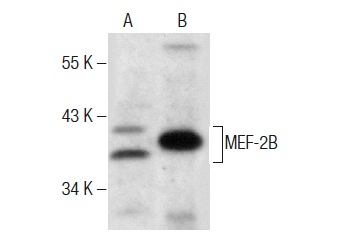
Western blot analysis of MEF-2B expression in C2C12 whole cell lysate (A) and mouse brain tissue extract (B).| Product Name | MEF-2B Antibody (M-84) |
|---|---|
| Antibody Type | Primary Antibodies |
| Antigen Alias | epitope corresponding to amino acids 207-285 mapping within an internal region of MEF-2B of mouse origin |
| Modification Notes | The myocyte enhancer factor-2 (MEF-2) family of transcription factors associate with co-repessors or co-activators to regulate development and function of T cells, neuronal cells, and muscle cells. Four family members, termed MEF-2A, -2B, -2C, and -2D, arise from alternatively spliced transcripts. These members bind as homo- and heterodimers to the MEF-2 site in the promoter region of affected genes. Differential regulation in the expression of the four transcripts implies functional distinction for each during embryogenesis and development. The process of differentiation from mesodermal precursor cells to myoblasts has led to the discovery of a variety of tissue-specific factors that regulate muscle gene expression. The myogenic basic helix-loop-helix proteins, including MyoD, myogenin, Myf-5, and MRF4, are one class of identified factors. The MEF-2 family represents a second class of DNA binding regulatory proteins. Each of these proteins binds to the MEF-2 target DNA sequence present in the regulatory regions of many muscle-specific genes. |
| Clonality | Polyclonal |
|---|---|
| Isotype | IgG |
| Host Species | Rabbit |
| Tested Applications | WBIPIFELISA |
| recommended for detection of MEF-2B of mouse and rat origin by WB, IP, IF and ELISA: |
|
| Species Reactivity | HumanMouseRat |
| Concentration | 1mg/ml |
| Purification | Affinity purified |
| Alternative Names | epitope corresponding to amino acids 207-285 mapping within an internal region of MEF-2B of mouse origin |
|---|---|
| Tissue Specificity | epitope corresponding to amino acids 207-285 mapping within an internal region of MEF-2B of mouse origin |
Application
Western blot analysis of MEF-2B expression in C2C12 whole cell lysate (A) and mouse brain tissue extract (B).| Application Notes | recommended for detection of MEF-2B of mouse and rat origin by WB, IP, IF and ELISA: |
|---|
| Form | Liquid |
|---|---|
| Storage Instructions | For short-term storage, store at 4° C. For long-term storage, aliquot and store at -20ºC or below. Avoid multiple freeze-thaw cycles. |
| Storage Buffer | phosphate buffered saline , pH 7.4, 150mM NaCl, 0.02% sodium azide and 50% glycerol. |


