Application
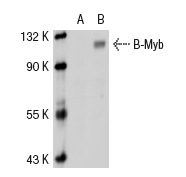
Western blot analysis of B-Myb expression in non-transfected: (A) and mouse B-Myb transfected: (B) 293T whole cell lysates.| Product Name | B-Myb Antibody (H-115) |
|---|---|
| Antibody Type | Primary Antibodies |
| Antigen Alias | epitope corresponding to amino acids 586-700 mapping at the C-terminus of B-Myb of human origin |
| Modification Notes | The highly leukemogenic avian retrovirus E26 contains two oncogenes, v-Myb and v-Ets, which are expressed together as a fusion protein. The cellular homolog of v-Myb, designated c-Myb, encodes a transcription factor. Deletion or disruption of a negative regulatory domain mapping within the carboxy terminal domain of c-Myb results in enhanced transactivating capacity and in parallel, leads to activation of its ability to transform hemopoietic cells. c-Myb is expressed preferentially, but not exclusively, in immature hemopoietic cells and its expression decreases as cells differentiate. A second member of the Myb proto-oncogene family, B-Myb, encodes a second sequence-specific DNA binding protein. B-Myb RNA levels are low or undetectable in quiescent cells but increase at the G1/S-phase transition following mitogenic stimulation. Studies suggest that B-Myb expression rescues cells from p53-induced G1 arrest mediated by p21. |
| Clonality | Polyclonal |
|---|---|
| Isotype | IgG |
| Host Species | Rabbit |
| Tested Applications | WBIPIFELISAGSChIP |
| recommended for detection of B-Myb of mouse, rat and human origin by WB, IP, IF and ELISA also reactive with additional species, including equine and canine: |
|
| Species Reactivity | HumanMouseRat |
| Concentration | 1mg/ml |
| Purification | Affinity purified |
| Alternative Names | epitope corresponding to amino acids 586-700 mapping at the C-terminus of B-Myb of human origin |
|---|---|
| Tissue Specificity | epitope corresponding to amino acids 586-700 mapping at the C-terminus of B-Myb of human origin |
| Entrez Gene | 4605 |
|---|
Application
Western blot analysis of B-Myb expression in non-transfected: (A) and mouse B-Myb transfected: (B) 293T whole cell lysates.| Application Notes | recommended for detection of B-Myb of mouse, rat and human origin by WB, IP, IF and ELISA also reactive with additional species, including equine and canine: |
|---|
| Form | Liquid |
|---|---|
| Storage Instructions | For short-term storage, store at 4° C. For long-term storage, aliquot and store at -20ºC or below. Avoid multiple freeze-thaw cycles. |
| Storage Buffer | phosphate buffered saline , pH 7.4, 150mM NaCl, 0.02% sodium azide and 50% glycerol. |


