Application
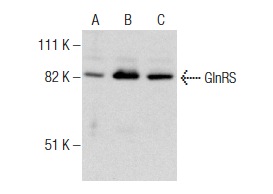
Western blot analysis of GlnRS expression in Jurkat (A), K-562 (B) and HL-60 (C) whole cell lysates.| Product Name | GlnRS Antibody (H-263) |
|---|---|
| Antibody Type | Primary Antibodies |
| Antigen Alias | epitope corresponding to amino acids 513-775 mapping at the C-terminus of GlnRS of human origin |
| Modification Notes | Aminoacyl-tRNA synthetases function to catalyze the aminoacylation of tRNAs by their corresponding amino acids, thus linking amino acids with tRNA-contained nucleotide triplets. GlnRS (Glutaminyl-tRNA synthetase), also known as QARS, is a 775 amino acid member of the class-I aminoacyl-tRNA synthetase family. Localized to the cytoplasm, GlnRS is part of a multi-protein complex composed of nine aminoacyl-tRNA synthetases that are specific for nine amino acids, namely Arg, Asp, Glu, Gln, Ile, Leu, Lys, Met and Pro. In this complex, GlnRS functions to catalyze the ATP-dependent conversion of L-glutamine (Gln) and tRNA(Gln) to Gln-tRNA(Gln). While GlnRS is used to synthesize Gln-tRNA(Gln) in many eukaryotic cells, prokaryotes and organelles, such as mitochondria and chloroplasts, can synthesize Gln-tRNA(Gln) in a two step process involving misacylation and amidation reactions. |
| Clonality | Polyclonal |
|---|---|
| Isotype | IgG |
| Host Species | Rabbit |
| Tested Applications | WBIPIFELISA |
| recommended for detection of GlnRS of mouse, rat and human origin by WB, IP, IF and ELISA also reactive with additional species, including equine, canine and bovine: |
|
| Species Reactivity | HumanMouseRat |
| Concentration | 1mg/ml |
| Purification | Affinity purified |
| Alternative Names | epitope corresponding to amino acids 513-775 mapping at the C-terminus of GlnRS of human origin |
|---|---|
| Tissue Specificity | epitope corresponding to amino acids 513-775 mapping at the C-terminus of GlnRS of human origin |
| Entrez Gene | 5859 |
|---|
Application
Western blot analysis of GlnRS expression in Jurkat (A), K-562 (B) and HL-60 (C) whole cell lysates.| Application Notes | recommended for detection of GlnRS of mouse, rat and human origin by WB, IP, IF and ELISA also reactive with additional species, including equine, canine and bovine: |
|---|
| Form | Liquid |
|---|---|
| Storage Instructions | For short-term storage, store at 4° C. For long-term storage, aliquot and store at -20ºC or below. Avoid multiple freeze-thaw cycles. |
| Storage Buffer | phosphate buffered saline , pH 7.4, 150mM NaCl, 0.02% sodium azide and 50% glycerol. |


