Application
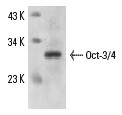
Western blot analysis of Oct-3/4 expression in mouse kidney tissue extract.Application
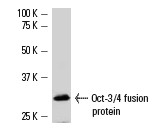
Western blot analysis of human recombinant Oct-3/4 fusion protein.| Product Name | Oct-3/4 Antibody (H-65) |
|---|---|
| Antibody Type | Primary Antibodies |
| Antigen Alias | epitope corresponding to amino acids 1-65 of Oct-3B of human origin |
| Modification Notes | POU5F1 (POU domain, class 5, transcription factor 1), also known as octamer-binding transcription factor-3 (Oct-3, OTF3), octamer-binding transcription factor-4 (Oct-4, Otf-4) and Oct-3/4, modulates embryonic stem (ES) cell populations by influencing lineage commitment. Oct-3/4 sustains stem-cell self-renewal and differentiation pathways. Transcription factors containing the POU homeodomain regulate tissue-specific gene expression in lymphoid and pituitary differentiation and in early mammalian development. Oct-3/4 is capable of inducing rapid proliferation and tumorigenic properties of ES cells through activation of the UTF1 gene. In humans, two Oct-3/4 isoforms contribute to influencing the undifferentiated phenotype of ES cells. Oct-3/4 pseudogenes localizing to human chromosomes 10 and 8 are reported to be transcribed in certain cancer cell lines and tissues. |
| Clonality | Polyclonal |
|---|---|
| Isotype | IgG |
| Host Species | Rabbit |
| Tested Applications | WBIPIFELISAGSChIP |
| recommended for detection of Oct-3B and, to a lesser extent, Oct-3A (Oct-4) of mouse, rat and human origin by WB, IP, IF and ELISA also reactive with additional species, including equine, bovine and porcine: |
|
| Species Reactivity | HumanMouseRat |
| Concentration | 1mg/ml |
| Purification | Affinity purified |
| Alternative Names | epitope corresponding to amino acids 1-65 of Oct-3B of human origin |
|---|---|
| Tissue Specificity | epitope corresponding to amino acids 1-65 of Oct-3B of human origin |
| Entrez Gene | 5460 |
|---|
Application
Western blot analysis of Oct-3/4 expression in mouse kidney tissue extract.
Application
Western blot analysis of human recombinant Oct-3/4 fusion protein.| Application Notes | recommended for detection of Oct-3B and, to a lesser extent, Oct-3A (Oct-4) of mouse, rat and human origin by WB, IP, IF and ELISA also reactive with additional species, including equine, bovine and porcine: |
|---|
| Form | Liquid |
|---|---|
| Storage Instructions | For short-term storage, store at 4° C. For long-term storage, aliquot and store at -20ºC or below. Avoid multiple freeze-thaw cycles. |
| Storage Buffer | phosphate buffered saline , pH 7.4, 150mM NaCl, 0.02% sodium azide and 50% glycerol. |


