Application
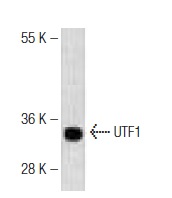
Western blot analysis of UTF1 expression in H460 whole cell lysate.| Product Name | UTF1 Antibody (F-23) |
|---|---|
| Antibody Type | Primary Antibodies |
| Antigen Alias | recommended for detection of UTF1 of human origin by WB, IP and ELISA |
| Modification Notes | UTF1 (undifferentiated embryonic cell transcription factor 1) is a 341 amino acid protein that localizes to the nucleus and is subject to post-translational phosphorylation. Associating with the TFIID complex via an interaction with the TATA box binding protein (TFIID), UTF1 binds to the N-terminal region of ATF-2 and, via this binding, acts as a transcriptional coactivator of ATF-2, thereby enhancing transcriptional activity. Human UTF1 shares 64% homology with its mouse counterpart, suggesting a similar role between species. The gene encoding UTF1 maps to human chromosome 10, which houses over 1,200 genes and comprises nearly 4.5% of the human genome. Defects in some of the genes that map to chromosome 10 are associated with Charcot-Marie Tooth disease, Jackson-Weiss syndrome, Usher syndrome, nonsyndromatic deafness, Wolman’s syndrome, Cowden syndrome, multiple endocrine neoplasia type 2 and porphyria. |
| Clonality | Polyclonal |
|---|---|
| Isotype | IgG |
| Host Species | Rabbit |
| Tested Applications | WBIPELISA |
| WB:1:500~1:2000 IP:1:100~1:500 Notes:Optimal dilutions/concentrations should be determined by the researcher. |
|
| Species Reactivity | HumanMouseRat |
| Concentration | 1mg/ml |
| Purification | Affinity purified |
| Alternative Names | recommended for detection of UTF1 of human origin by WB IP and ELISA |
|---|---|
| Tissue Specificity | recommended for detection of UTF1 of human origin by WB, IP and ELISA |
| Entrez Gene | 8433 |
|---|
Application
Western blot analysis of UTF1 expression in H460 whole cell lysate.| Application Notes | WB:1:500~1:2000 IP:1:100~1:500 Notes:Optimal dilutions/concentrations should be determined by the researcher. |
|---|
| Form | Liquid |
|---|---|
| Storage Instructions | For short-term storage, store at 4° C. For long-term storage, aliquot and store at -20ºC or below. Avoid multiple freeze-thaw cycles. |
| Storage Buffer | phosphate buffered saline , pH 7.4, 150mM NaCl, 0.02% sodium azide and 50% glycerol. |


