Application
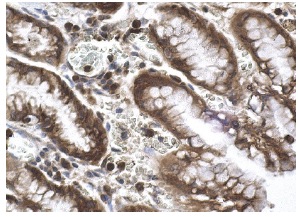
Immunoperoxidase staining of formalin fixed, paraffin-embedded human stomach tissue showing cytoplasmic staining of glandular cells.| Product Name | TGFβ1/2/3 Antibody (H-112) |
|---|---|
| Antibody Type | Primary Antibodies |
| Antigen Alias | epitope corresponding to amino acids 301-412 mapping at the C-terminus of TGFβ1 of human origin |
| Modification Notes | Transforming growth factor betas (TGF∫s) were originally discovered due to their ability to promote anchorage-independent growth of rat NRK fibroblasts in the presence of TGFå. It is now realized that TGF∫s mediate many cell-cell interactions that occur during embryonic development. Three TGF∫s have been identified in mammals. TGF∫1, TGF∫2 and TGF∫3 are each synthesized as precursor proteins that are very similar in that each is cleaved to yield a 112 amino acid polypeptide that remains associated with the latent portion of the molecules. Biologically active TGF∫ requires dimerization of the monomers (usually homodimers) and release of the latent peptide portion. Overall, the mature region of the TGF∫3 protein has approximately 80% identity to the mature region of both TGF∫1 and TGF∫2. However, the NH2 terminals or precursor regions of their molecules share only 27% sequence identity. |
| Clonality | Polyclonal |
|---|---|
| Isotype | IgG |
| Host Species | Rabbit |
| Tested Applications | WBIPIFELISA |
| recommended for detection of TGFβ1, TGFβ2 and TGFβ3 of mouse, rat, human and Xenopus origin by WB, IP, IF and ELISA also reactive with additional species, including equine, canine, bovine, porcine and avian: |
|
| Species Reactivity | HumanMouseRat |
| Concentration | 1mg/ml |
| Purification | Affinity purified |
| Alternative Names | epitope corresponding to amino acids 301-412 mapping at the C-terminus of TGF&beta 1 of human origin |
|---|---|
| Tissue Specificity | epitope corresponding to amino acids 301-412 mapping at the C-terminus of TGFβ1 of human origin |
| Entrez Gene | 7040 |
|---|
Application
Immunoperoxidase staining of formalin fixed, paraffin-embedded human stomach tissue showing cytoplasmic staining of glandular cells.| Application Notes | recommended for detection of TGFβ1, TGFβ2 and TGFβ3 of mouse, rat, human and Xenopus origin by WB, IP, IF and ELISA also reactive with additional species, including equine, canine, bovine, porcine and avian: |
|---|
| Form | Liquid |
|---|---|
| Storage Instructions | For short-term storage, store at 4° C. For long-term storage, aliquot and store at -20ºC or below. Avoid multiple freeze-thaw cycles. |
| Storage Buffer | phosphate buffered saline , pH 7.4, 150mM NaCl, 0.02% sodium azide and 50% glycerol. |


