Application
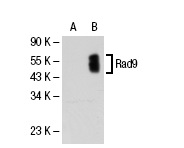
Western blot analysis of Rad9 expression in non-transfected: (A) and human Rad9 transfected: (B) 293T whole cell lysates.Application
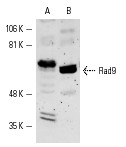
Western blot analysis of Rad9 expression in HeLa (A) and KNRK (B) whole cell lysates.| Product Name | Rad9 Antibody (M-389) |
|---|---|
| Antibody Type | Primary Antibodies |
| Antigen Alias | epitope corresponding to amino acids 1-389 representing full length Rad9 of mouse origin |
| Modification Notes | DNA damage or incomplete replication of DNA results in the inhibition of cell cycle progression at the G1 to S or G2 to M phase checkpoints by conserved regulatory mechanisms. Chk1, Rad9 and Hus1 are involved in the signal transduction cascade that regulates cell cycle arrest at the G2 checkpoint. Chk1 functions as an essential component in the G2 phase DNA damage checkpoint, as it phosphorylates Cdc25C in response to DNA damage and thereby inhibits mitosis. Two related mammalian proteins, Hus1 and Rad9, share conserved sequence identity and function to the yeast homologs of the same names. In vivo, Rad9 is highly phosphorylated and directly associates with two other checkpoint control proteins, Rad1 and Hus1. Additionally, Rad9 associates with anti-apoptotic Bcl-2 family proteins Bcl-2 and Bcl-xL, but not with the pro-apoptotic Bax and Bad proteins. Overexpression of Rad9 induces apoptosis and indicates that Rad9 may have an additional role in regulating apoptosis after DNA damage. |
| Clonality | Polyclonal |
|---|---|
| Isotype | IgG |
| Host Species | Rabbit |
| Tested Applications | WBIPIFELISA |
| recommended for detection of Rad9 of mouse, rat and human origin by WB, IP, IF and ELISA: |
|
| Species Reactivity | HumanMouseRat |
| Concentration | 1mg/ml |
| Purification | Affinity purified |
| Alternative Names | epitope corresponding to amino acids 1-389 representing full length Rad9 of mouse origin |
|---|---|
| Tissue Specificity | epitope corresponding to amino acids 1-389 representing full length Rad9 of mouse origin |
| Entrez Gene | 5883 |
|---|
Application
Western blot analysis of Rad9 expression in non-transfected: (A) and human Rad9 transfected: (B) 293T whole cell lysates.
Application
Western blot analysis of Rad9 expression in HeLa (A) and KNRK (B) whole cell lysates.| Application Notes | recommended for detection of Rad9 of mouse, rat and human origin by WB, IP, IF and ELISA: |
|---|
| Form | Liquid |
|---|---|
| Storage Instructions | For short-term storage, store at 4° C. For long-term storage, aliquot and store at -20ºC or below. Avoid multiple freeze-thaw cycles. |
| Storage Buffer | phosphate buffered saline , pH 7.4, 150mM NaCl, 0.02% sodium azide and 50% glycerol. |


