Application
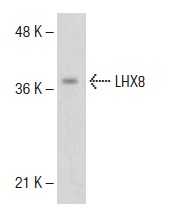
Western blot analysis of LHX8 expression in Hep G2 whole cell lysate.| Product Name | LHX8 Antibody (S-22) |
|---|---|
| Antibody Type | Primary Antibodies |
| Antigen Alias | recommended for detection of LHX8 of mouse, rat and human origin by WB, IP and ELISA; also reactive with additional species, including canine |
| Modification Notes | The LIM domain (a zinc finger structure) is a protein-protein interaction motif found in several protein superfamilies, including homeodomain transcription factors and kinases. The LIM family of homeodomain proteins play a role in organismal differentiation and development. During murine development, the LHX8 gene is expressed in the medical ganglionic eminence and the mesenchyme surrounding the oral cavity. Specifically, the LHX8 gene is expressed in the maxillary and mandibular processes and the ventral forebrain in the developing mouse embryo. Furthermore, Lhx8 is continuously expressed in the mesenchyme of mouse palatal structures and plays an essential role in palate development. LHX8(-) mice develop a cleft secondary palate due to a failure of the palatal shelves to connect and fuse properly. The murine LHX8 gene, which is composed of nine exons and eight introns, maps to the distal portion of chromosome 3 (band H3-4). |
| Clonality | Polyclonal |
|---|---|
| Isotype | IgG |
| Host Species | Rabbit |
| Tested Applications | WBIPELISA |
| WB:1:500~1:2000 IP:1:100~1:500 Notes:Optimal dilutions/concentrations should be determined by the researcher. |
|
| Species Reactivity | HumanMouseRat |
| Concentration | 1mg/ml |
| Purification | Affinity purified |
| Alternative Names | recommended for detection of LHX8 of mouse rat and human origin by WB IP and ELISA also reactive with additional species including canine |
|---|---|
| Tissue Specificity | recommended for detection of LHX8 of mouse, rat and human origin by WB, IP and ELISA; also reactive with additional species, including canine |
| Entrez Gene | 431707 |
|---|
Application
Western blot analysis of LHX8 expression in Hep G2 whole cell lysate.| Application Notes | WB:1:500~1:2000 IP:1:100~1:500 Notes:Optimal dilutions/concentrations should be determined by the researcher. |
|---|
| Form | Liquid |
|---|---|
| Storage Instructions | For short-term storage, store at 4° C. For long-term storage, aliquot and store at -20ºC or below. Avoid multiple freeze-thaw cycles. |
| Storage Buffer | phosphate buffered saline , pH 7.4, 150mM NaCl, 0.02% sodium azide and 50% glycerol. |


