Application
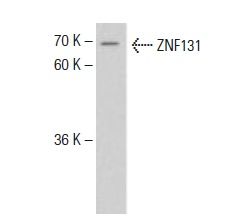
Western blot analysis of ZNF131 expression in Jurkat whole cell lysate.Application
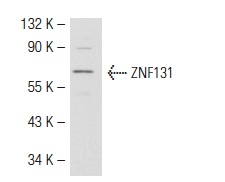
Western blot analysis of ZNF131 expression in 293T whole cell lysate.| Product Name | ZNF131 Antibody (U-24) |
|---|---|
| Antibody Type | Primary Antibodies |
| Antigen Alias | recommended for detection of ZNF131 of mouse, rat and human origin by WB, IP and ELISA; also reactive with additional species, including canine |
| Modification Notes | Zinc-finger proteins contain DNA-binding domains and have a wide variety of functions, most of which encompass some form of transcriptional activation or repression. The majority of zinc-finger proteins contain a Krüppel-type DNA binding domain and a KRAB domain, which is thought to interact with KAP1, thereby recruiting histone modifying proteins. As a member of the krueppel C2H2-type zinc-finger protein family, ZNF131 (Zinc finger protein 131) is a 623 amino acid nuclear protein that contains one BTB (POZ) domain and six C2H2-type zinc fingers. With predominant expression found in brain, it is likely that ZNF131 plays a role as a transcription regulator during development and organogenesis of the adult central nervous system. ZNF131 also represses ERå (Estrogen receptor alpha)-mediated transactivation by interrupting ERå binding to the estrogen-response element. There are two isoforms of ZNF131 that are produced as a result of alternative splicing events. |
| Clonality | Polyclonal |
|---|---|
| Isotype | IgG |
| Host Species | Rabbit |
| Tested Applications | WBIPELISA |
| WB:1:500~1:2000 IP:1:100~1:500 Notes:Optimal dilutions/concentrations should be determined by the researcher. |
|
| Species Reactivity | HumanMouseRat |
| Concentration | 1mg/ml |
| Purification | Affinity purified |
| Alternative Names | recommended for detection of ZNF131 of mouse rat and human origin by WB IP and ELISA also reactive with additional species including canine |
|---|---|
| Tissue Specificity | recommended for detection of ZNF131 of mouse, rat and human origin by WB, IP and ELISA; also reactive with additional species, including canine |
| Entrez Gene | 7690 |
|---|
Application
Western blot analysis of ZNF131 expression in Jurkat whole cell lysate.
Application
Western blot analysis of ZNF131 expression in 293T whole cell lysate.| Application Notes | WB:1:500~1:2000 IP:1:100~1:500 Notes:Optimal dilutions/concentrations should be determined by the researcher. |
|---|
| Form | Liquid |
|---|---|
| Storage Instructions | For short-term storage, store at 4° C. For long-term storage, aliquot and store at -20ºC or below. Avoid multiple freeze-thaw cycles. |
| Storage Buffer | phosphate buffered saline , pH 7.4, 150mM NaCl, 0.02% sodium azide and 50% glycerol. |


