Application
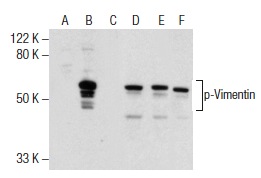
Antibodies tested include p-Vimentin (Ser 83): (A,B,C) and Vimentin (C-20)-R: (D,E,F).Application
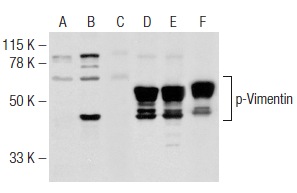
Antibodies tested include p-Vimentin (Ser 83): (A,B,C) and Vimentin (V9): (D,E,F).| Product Name | p-Vimentin Antibody (Ser 83) |
|---|---|
| Antibody Type | Primary Antibodies |
| Antigen Alias | recommended for detection of Ser 83 phosphorylated Vimentin of human origin by WB and ELISA |
| Modification | Phosphoralated |
| Modification Notes | Phosphorylation of Vimentin on specific amino acid residues, such as Ser 83 and Ser 71, induces disassembly of Vimentin intermediate filaments in vivo and in vitro. Binding of 14-3-3 depends on Vimentin phosphorylation and requires the phosphopeptide binding domain of 14-3-3, which is an amino terminal head domain consisting of amino acids 1-96. Phosphorylated Vimentin sequesters 14-3-3 and limits its availability to other target proteins, which can affect intracellular signaling processes that require 14-3-3. The amino-terminal domain of Vimentin is the target site for several protein kinases, including Rho kinase and PKC. The disruption of subcellular compartmentalization of interphase cells leads to PKC-mediated phosphorylation of Vimentin. Thus, targeting of activated PKC, coupled with the reorganization of intracellular membranes which contain phospholipids essential for activation, leads to the mitosis-specific phosphorylation of Vimentin. |
| Clonality | Polyclonal |
|---|---|
| Isotype | IgG |
| Host Species | Rabbit |
| Tested Applications | WBIPELISA |
| WB:1:500~1:2000 IP:1:100~1:500 Notes:Optimal dilutions/concentrations should be determined by the researcher. |
|
| Species Reactivity | HumanMouseRat |
| Concentration | 1mg/ml |
| Purification | Affinity purified |
| Alternative Names | recommended for detection of Ser 83 phosphorylated Vimentin of human origin by WB and ELISA |
|---|---|
| Tissue Specificity | recommended for detection of Ser 83 phosphorylated Vimentin of human origin by WB and ELISA |
| Entrez Gene | 7431 |
|---|
Application
Antibodies tested include p-Vimentin (Ser 83): (A,B,C) and Vimentin (C-20)-R: (D,E,F).
Application
Antibodies tested include p-Vimentin (Ser 83): (A,B,C) and Vimentin (V9): (D,E,F).| Application Notes | WB:1:500~1:2000 IP:1:100~1:500 Notes:Optimal dilutions/concentrations should be determined by the researcher. |
|---|
| Form | Liquid |
|---|---|
| Storage Instructions | For short-term storage, store at 4° C. For long-term storage, aliquot and store at -20ºC or below. Avoid multiple freeze-thaw cycles. |
| Storage Buffer | phosphate buffered saline , pH 7.4, 150mM NaCl, 0.02% sodium azide and 50% glycerol. |


