WB
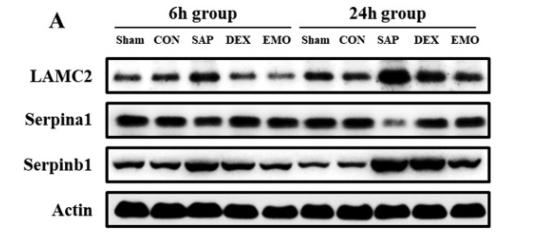
Validation of Lamc2, Serpina1, Serpinb1 by Western Blot analyses. Representative images of Western Blot of 3 differentially expressed proteins in each group (A).| Product Name | SerpinB1 Antibody (H-40) |
|---|---|
| Antibody Type | Primary Antibodies |
| Modification Notes | The serine proteinase inhibitors (serpins) compose a superfamily of proteins with a diverse set of functions, including the control of blood coagulation, complement activation, programmed cell death and development. Serpins are secreted glycoproteins that contain a stretch of peptide that mimics a true substrate for a corresponding serine protease. The monocyte/neutrophil elastase inhibitor gene, SERPINB1, belongs to the Ov-serpin family (ovalbumin-related serpins). Human SerpinB1, also designated monocyte/neutrophil elastase inhibitor (M/NEI) or leukocyte elastase inhibitor (LEI), is a cytoplasmic protein which acts as a fast-acting stoichiometric proteinase inhibitor that regulates the activity of neutrophil elastase (NE), cathepsin-G and proteinase-3. There are four homologous genes in mouse designated SerpinB1a, SerpinB1b, SerpinB1c and the pseudogene, Serpinb1-ps1. The three protein-coding genes share significant sequence identity, however SerpinB1a (also designated EIA) has been characterized as the functional ortholog of human SerpinB1. |
| Clonality | Polyclonal |
|---|---|
| Isotype | IgG |
| Host Species | Rabbit |
| Tested Applications | ELISAIFIPWB |
| recommended for detection of SerpinB1 of mouse, rat and human origin by WB, IP, IF and ELISA: |
|
| Species Reactivity | HumanMouseRat |
| Concentration | 1mg/ml |
| Purification | Affinity purified |
| Alternative Names | epitope corresponding to amino acids 101-140 mapping within an internal region of SerpinB1 of human origin |
|---|---|
| Tissue Specificity | epitope corresponding to amino acids 101-140 mapping within an internal region of SerpinB1 of human origin |
| Entrez Gene | 1992 |
|---|
WB
Validation of Lamc2, Serpina1, Serpinb1 by Western Blot analyses. Representative images of Western Blot of 3 differentially expressed proteins in each group (A).| Application Notes | recommended for detection of SerpinB1 of mouse, rat and human origin by WB, IP, IF and ELISA: |
|---|
| Form | Liquid |
|---|---|
| Storage Instructions | For short-term storage, store at 4° C. For long-term storage, aliquot and store at -20ºC or below. Avoid multiple freeze-thaw cycles. |
| Storage Buffer | phosphate buffered saline , pH 7.4, 150mM NaCl, 0.02% sodium azide and 50% glycerol. |


