Application
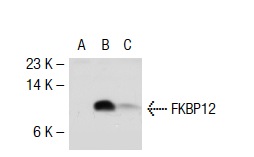
Western blot analysis of FKBP12 expression in non-transfected 293T: (A), mouse FKBP12 transfected 293T: (B) and human PBL (C) whole cell lysates.| Product Name | FKBP12 Antibody (FL-108) |
|---|---|
| Antibody Type | Primary Antibodies |
| Antigen Alias | epitope corresponding to amino acids 1-108 representing full length FKBP12 of human origin |
| Modification Notes | Immunophilins are a highly conserved family of cis-trans peptidyl-prolyl isomerases which bind to and mediate the effects of immunosuppressive drugs such as Cyclosporin, FK506 and Rapamycin. The prototypic member of the family, FKBP12, was originally identified as a target of FK506 and Rapamycin activity. FKBP12 is an abundant, evolutionarily conserved cytoplasmic protein. Although the molecular role of FKBP12 activity is not well understood, the protein has been implicated as a regulator of diverse array of cellular processes including T cell activation, entry into the cell cycle and intracellular calcium release. Interestingly, FKBP12 has been shown to associate with the intracellular cytoplasmic domain of the type I TGF∫ receptor. This association is constitutive and not dependent on the activation of the receptor. |
| Clonality | Polyclonal |
|---|---|
| Isotype | IgG |
| Host Species | Rabbit |
| Tested Applications | WBIPIFELISA |
| recommended for detection of FKBP12 and FKBP12.6, and, to a lesser extent, FKBP13, 51 and 52 of mouse, rat and human origin by WB, IP, IF and ELISA also reactive with additional species, including bovine, porcine and avian: |
|
| Species Reactivity | HumanMouseRat |
| Concentration | 1mg/ml |
| Purification | Affinity purified |
| Alternative Names | epitope corresponding to amino acids 1-108 representing full length FKBP12 of human origin |
|---|---|
| Tissue Specificity | epitope corresponding to amino acids 1-108 representing full length FKBP12 of human origin |
| Entrez Gene | 2280 |
|---|
Application
Western blot analysis of FKBP12 expression in non-transfected 293T: (A), mouse FKBP12 transfected 293T: (B) and human PBL (C) whole cell lysates.| Application Notes | recommended for detection of FKBP12 and FKBP12.6, and, to a lesser extent, FKBP13, 51 and 52 of mouse, rat and human origin by WB, IP, IF and ELISA also reactive with additional species, including bovine, porcine and avian: |
|---|
| Form | Liquid |
|---|---|
| Storage Instructions | For short-term storage, store at 4° C. For long-term storage, aliquot and store at -20ºC or below. Avoid multiple freeze-thaw cycles. |
| Storage Buffer | phosphate buffered saline , pH 7.4, 150mM NaCl, 0.02% sodium azide and 50% glycerol. |


